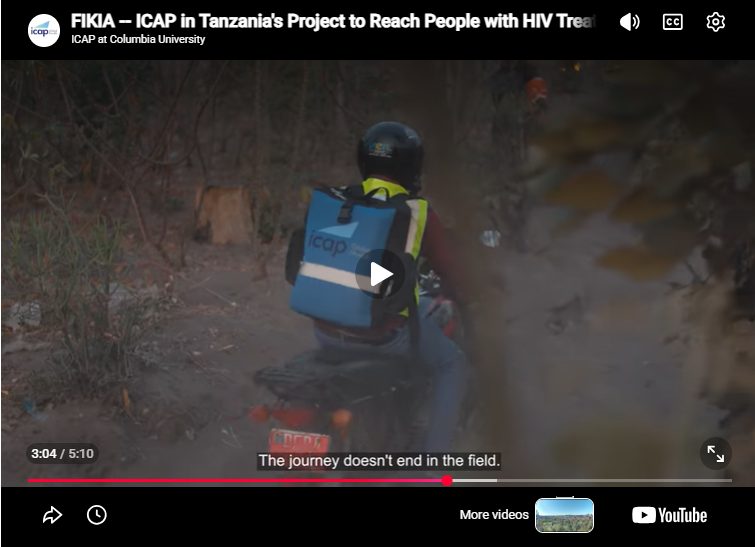
For more than a decade, ICAP’s groundbreaking FIKIA and FIKIA+ projects have sought the Republic of Tanzania’s longstanding HIV epidemic by going out into communities by boat, bicycle, or good old-fashioned shoe-leather.. The word “FIKIA” means “to reach” in the Kiswahili language, and reaching out is exactly what this unique program is all about, as a new video from ICAP in Tanzania demonstrates.
The video, which recently debuted at the 13th Tanzania Health Summit 2026 (see related story), presents a vivid portrait of how FIKIA works and the impact it has made.
The simple but critical concept behind FIKIA is that making progress toward control of HIV in Tanzania requires going beyond the walls of hospitals and clinics. It calls for reaching out to people where they live, work, and socialize — especially those people most at risk for acquiring or transmitting HIV.
Since FIKIA first launched in a productive collaboration between the Tanzania Ministry of Health and ICAP — with funding from the US President’s Emergency Plan for AIDS Relief (PEPFAR) through the Centers for Disease Control and Prevention — the program has brought critical HIV health services directly to communities in Tanzania, via motorcycle, mobile clinic, car, and boat. These HIV health services have connected effectively with the populations that run the hightest risk for HIV – sex workers, people who inject drugs, men who have sex with men (MSM), adolescent girls and young women, migrant workers, fisherfolk, and miners.
During its first phase, the FIKIA project reached more than two million individuals with HIV prevention, testing, treatment, and counseling services through innovations like backpack testing, which, as the name implies, lets health care workers bring testing to people at risk of HIV wherever they are in the community.
Building on the successes and lessons learned of the landmark program, ICAP embarked on FIKIA Plus in 2021 with the aim to support health facility and community-based HIV services that are tailored to the needs and preferences of communities in Mwanza and Geita, areas determined to be key priority areas for reaching epidemic control in the country.
The video was written, produced, filmed, and edited entirely by a team from ICAP in Tanzania consisting of Elizabeth Herman, Ayoub Msalilwa, and Fatuma Hassan, offering a luminous and memorable look at a project that has been leaving a legacy of improved health and wellbeing in Tanzania.
You can watch the video here:
About ICAP
A major global health organization that has been improving public health in countries around the world for two decades, ICAP works to transform the health of populations through innovation, science, and global collaboration. Based at Columbia Mailman School of Public Health, ICAP has projects in more than 40 countries, working side-by-side with ministries of health and local governmental, non-governmental, academic, and community partners to confront some of the world’s greatest health challenges. Through evidence-informed programs, meaningful research, tailored technical assistance, effective training and education programs, and rigorous surveillance to measure and evaluate the impact of public health interventions, ICAP aims to realize a global vision of healthy people, empowered communities, and thriving societies. Online at icap.columbia.edu