-
Date: November 23, 2026
-
Start Time: 8:00 am
End Time: 9:00 am
-
Location: Online
Building Health Systems Resilience in Africa Through Real World Solutions to Complex Problems
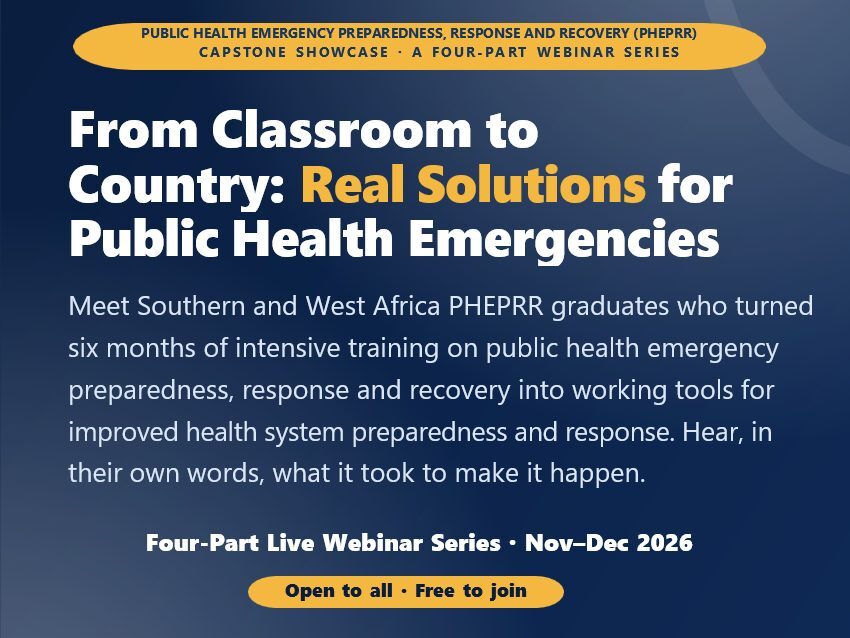
Southern and West Africa face a dual threat of recurring outbreaks like cholera, measles, and Lassa fever alongside climate shocks such as floods and cyclones. Past responses have taught a hard lesson: plans on paper only become capability when a skilled workforce can execute them. The Southern and West Africa Public Health Emergency Preparedness, Response, and Recovery (PHEPRR) Fellowship trained public health professionals to skillfully address these challenges.
A critical component of the Fellowship is a Capstone project in which Fellows identify a preparedness, response or recovery gap in their setting and aim to develop solutions to address it. Each capstone took a complex, high-stakes challenge and addressed it with a practical, low-barrier innovation that other teams and countries can readily adapt.
Across four live sessions, these PHEPRR graduates will walk us through what they built, the obstacles they hit, and the ideas you can borrow and use tomorrow.
The series is free of charge and open to all.
Why This Series Matters
- See what works on the ground | Each session features standout capstones chosen for their rigor and potential real-world impact — from aligning national cholera plans with WHO standards to building lab activation protocols and unifying surveillance data flows.
- Borrow ideas you can use tomorrow | Presenters share the methods, the obstacles, and the lessons behind their work. Whether you sit in a ministry, a district office, a lab, or a health facility, you’ll leave with approaches you can readily adopt and adapt to your setting.
- Connect across borders | Public health emergencies don’t respect boundaries. This series brings together fellows, mentors, and partners from two regions to build the shared language and relationships that make coordinated response possible.
The Four-Part Agenda
Session One | Monday, November 23 | 8-9am ET · 1-2pm WAT · 2-3pm SAST
- Community-Based ART/TB Refill Models as Emergency Response Tools: Evaluating Scalability and Integration into Emergency Operations | Ruramai Chisango, South Africa
- Implementation of a Pilot Psychotrauma Support System to Strengthen Preparedness, Response and Recovery from Public Health Emergencies in the Bousse Health District | Coulibaly Seydou, Burkina Faso
- Development of a One Health Intelligence Dashboard for the National Public Health Laboratory | Makhosazane Simontte Mawelela, Eswatini
- Development of an Evidence-Informed Clinical Suspicion Tool for Early Recognition of Lassa Fever in Pregnant Women Presenting with Obstetric Emergencies | Anna Peter, Nigeria
Session Two | Monday, November 30 | 8-9am ET · 1-2pm WAT · 2-3pm SAST
- Transforming Urban WASH Responses: A Predictive, Risk-Informed RCCE Framework for Mitigating Recurrent Waterborne Epidemics in Harare, Zimbabwe, 2026 | Israel Pondayi, Zimbabwe
- Development of an Annual Multi-Hazard Contingency Plan Through Risk Assessment Using the STAR Tool: Haho Health District Case, 2026 | Komi Akliku, Togo
- Turning Influenza Surveillance into Early Warning | Goodluck Ikwudiuto, Nigera
Session Three | Monday, December 7 | 8-9am ET · 1-2pm WAT · 2-3pm SAST
- Public Health Risk Assessment of Liquefied Petroleum Gas (LPG) Outlets in Residential Areas: Safety, Regulation, and Community Protection in Epworth, Harare, Zimbabwe | Margaret Tawodzera, Zimbabwe
- Development of Community-Based One Health Surveillance Tools for Strengthening Early Detection and Coordination of Priority Zoonotic Diseases in Zamfara State, Nigeria | Muhammad Jibril, Nigeria
- Assessing Hand Hygiene Compliance Among Healthcare Workers in the Surgical Ward at Kanifing General Hospital | Isatou Samba, The Gambia
Session Four | Monday, December 14 | 8-9am ET · 1-2pm WAT · 2-3pm SAST
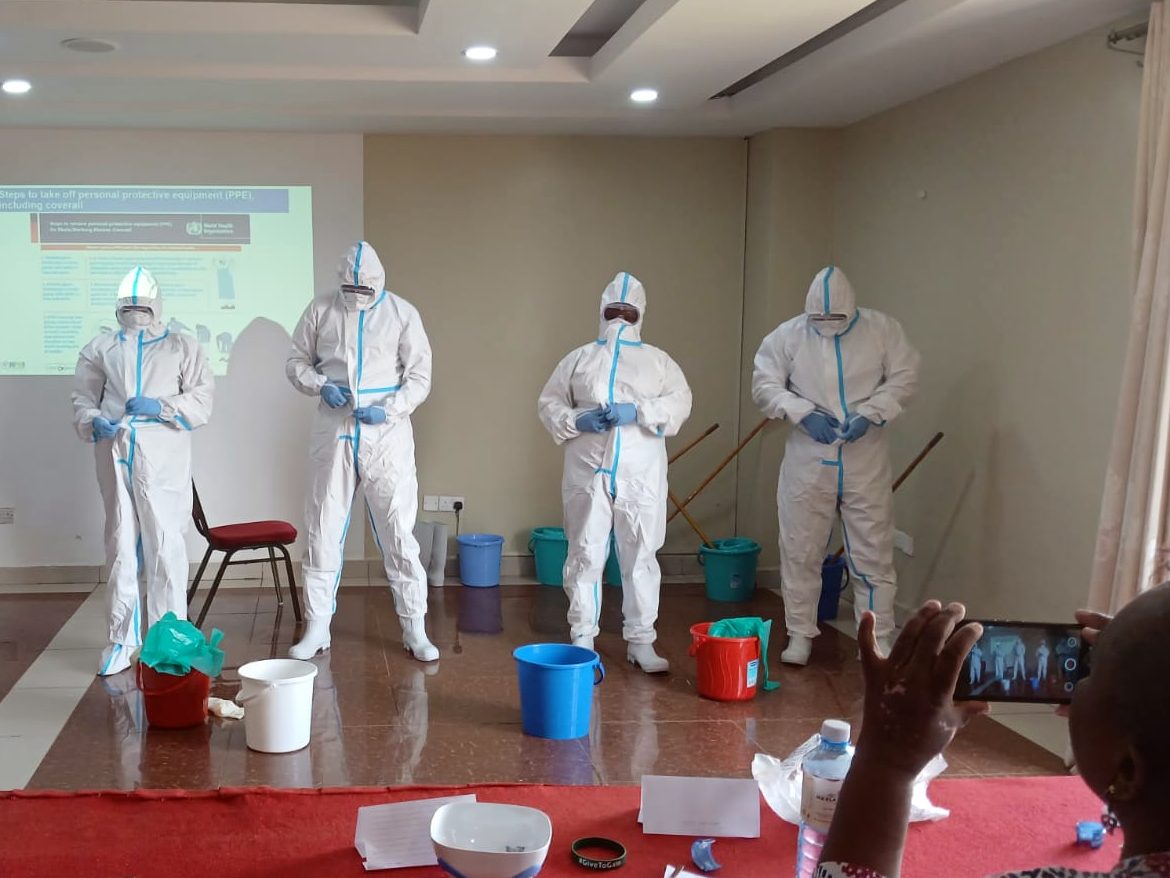
- Strengthening Public Health Workforce Readiness and Surge Capacity Through a Competency-Based Occupational Health and Safety Training Curriculum and Cascade Trainings | Aisha Mutjaba Muhammad, Nigeria
- A Digital Dynamic Mapping Platform for Public Health Emergency Management Stakeholders in Guinea | Housseynatou Diallo, Guinea
- Assessing Weekly IDSR Reporting Performance and Developing a Facility Performance League Table to Strengthen Surveillance Reporting in East Mamprusi Municipality | Suglo Ametus, Ghana
Reserve Your Spot
Join public health professionals, partners, and leaders from around the world. Register once for the full series — or drop in to the sessions that matter most to you.
Questions?
Contact Claire Raether at cr3144@cumc.columbia.edu or Barbara Villela at bsv2116@cumc.columbia.edu or Mays Shamout at olv6@cdc.gov.
About the PHEPRR Fellowship
The PHEPRR Fellowship is a highly competitive training program delivered by ICAP at Columbia University in partnership with the U.S. CDC. It equips mid- to senior-level public health professionals with no or limited formal emergency-response training with the practical skills to strengthen how their health systems prepare for, respond to, and recover from public health emergencies. Rather than passive lectures, the program is built on hands-on, “learning by doing” methods including a real-world capstone project applied directly on the job.
- Who it’s for | Mid- and senior-level public health professionals across Southern and West Africa, bringing experience from surveillance, laboratory, clinical, and operational roles.
- How it’s delivered | A blended fellowship combining in-person workshops focused on experiential learning, virtual sessions with global experts, and guided mentorship from a leader in national emergency management.
- What they practice | Curriculum adapted to regional contexts, high-fidelity functional exercises, practice with the full preparedness–response–recovery cycle including risk assessments, incident management systems, and stakeholder engagement.
- The Capstone | Each fellow designs and implements a project that closes a real preparedness, response or gap in their own institution — the very work showcased in this webinar series.

The mark “CDC” is owned by the US Dept. of Health and Human Services and is used with permission. Use this logo is not an endorsement by HHS or CDC of any particular product, service, or enterprise.