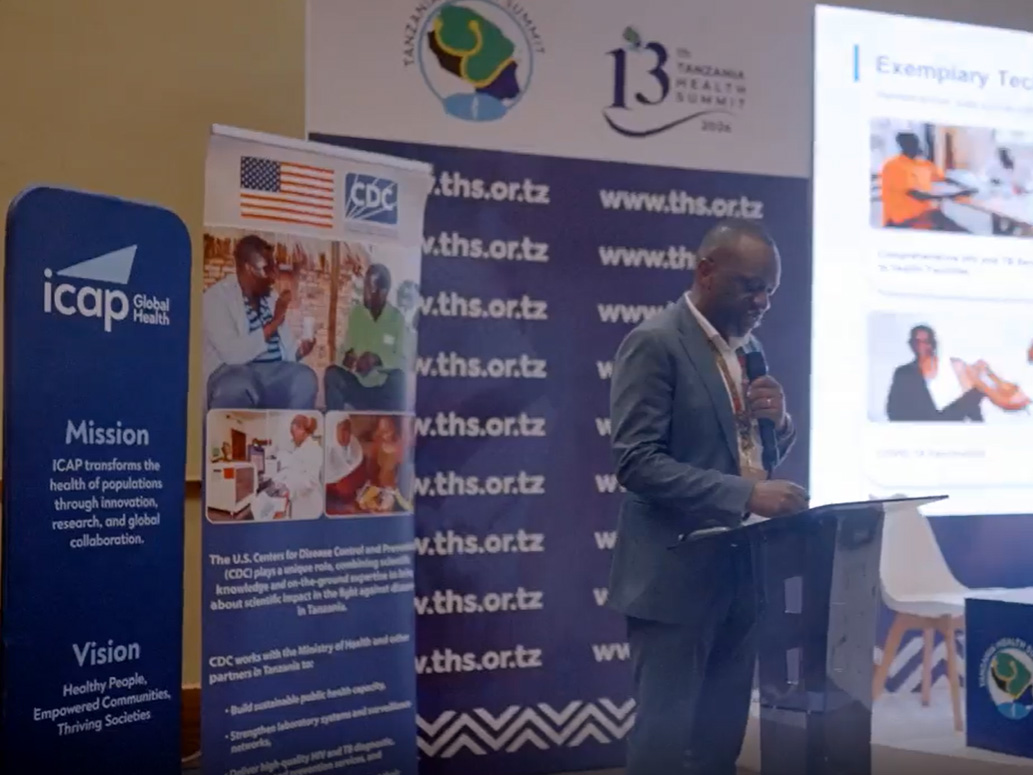
ICAP’s innovative FIKIA+ project took center stage at the 13th Tanzania Health Summit, which took place in Dar es Salaam on October 7, 2026.
The summit, which examined how Tanzania can sustain HIV epidemic-control gains as financing and implementation arrangements evolve, brought together representatives from national and local government, CDC Tanzania, the Tanzania Commission for AIDS (TACAIDS), academia, regional health leadership, service users, and the leaders of ICAP’s team in Tanzania, under the theme, Achieving HIV Epidemic Control with Health Sovereignty.
The participants convened around a central question currently at the heart of global health discussions worldwide: “How can the achievements of two decades of government leadership, partner investment, health-worker effort, and community engagement be converted into capabilities that remain nationally and locally owned, financed and managed?”
The event was divided into two parts – a policy-level discussion and the implementation experience from Mwanza and Geita. Whereas the policy panel focused on ownership, domestic financing, accountability, research and the future role of partners, the implementation panel explored the systems required to maintain delivery, including the workforce, commodities, laboratories, data, community platforms and responsive service models.
Across both panels, participants emphasized that health sovereignty does not mean working without partners; it means strengthening government-led systems so that essential services continue and remain accessible as project funding and delivery arrangements change.
The policy panel considered what Tanzania needs to institutionalize so that HIV services remain effective and reliable beyond individual projects. Speakers discussed the importance of defining government responsibilities, aligning financing with those responsibilities, reducing fragmentation and using evidence to guide national and local decisions. The panel also considered how partners can adapt their roles as government systems assume greater responsibility for routine functions.
The implementation panel brought ICAP and the FIKIA+ project into the spotlight, especially with the premiere of a short feature video about the project.
The implementation panel examined the operational conditions needed to sustain HIV outcomes in Mwanza and Geita, where FIKIA+ activities are focused. In framing remarks, John Kahemele, MD, ICAP’s country director in Tanzania, emphasized that program results represent people who need continuing access to care, not simply numerical in a spreadsheet.
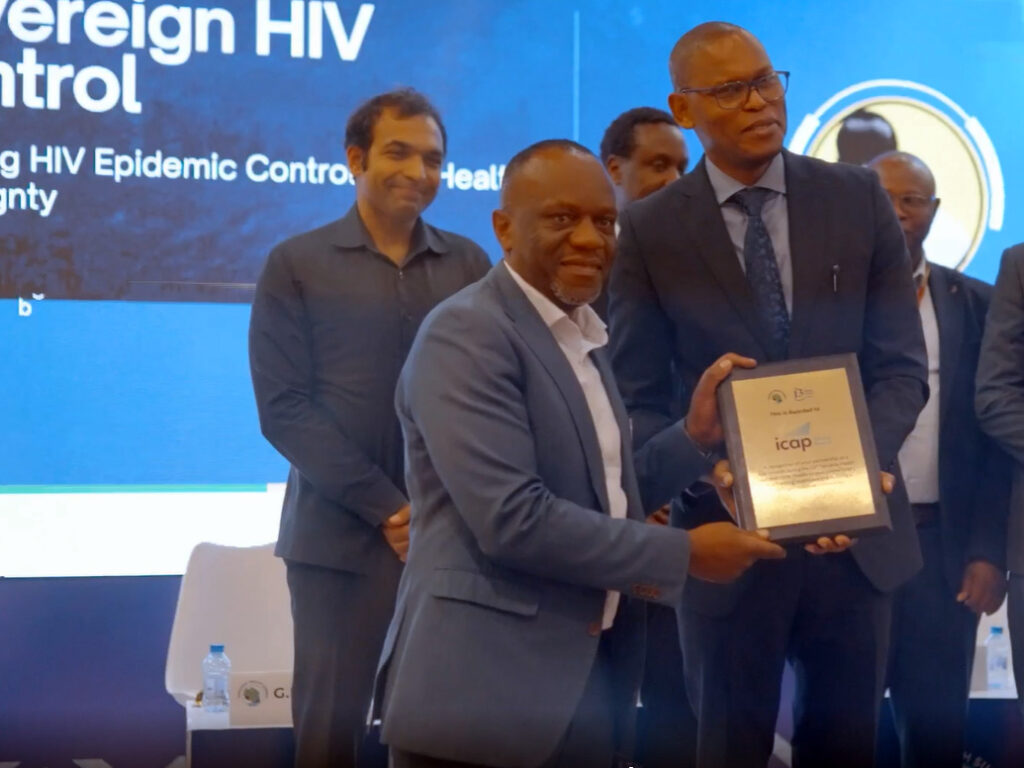
ICAP country director John Kahemele, MD, receives a plaque recognizing ICAP’s contributions to the HIV epidemic response in Tanzania at the 13th Tanzania Health Summit in Dar es Salaam on October 7, 2026.
“When we speak about progress in HIV, we often speak in numbers but you will all agree with me that the true meaning of progress deeply resides in humanity,” Kahemele told the audience. “We are talking about a parent who stays healthy enough to raise a child. We are talking about a young person who can plan a future. We’re also talking about a family that is able to live with hope.”
His remarks also stressed the vibrant partnership that has brought such success to Tanzania.
“Tanzania has achieved remarkable progress and these achievements could not be possible if there wasn’t a good partnership,” he said. “So we honor the government leadership, the government of Tanzania, but also the support that we’ve been receiving from the US government through PEPFAR then and now US government through the Department of State and the CDC and the dedication of health care workers and communities.”
In the context of partnership, he stressed that reliable services depend on trained and supported health workers, functioning laboratories, available commodities, usable data and community follow-up. These capabilities must remain effective after a project’s funding cycle ends.
“And to the people we’re living with HIV and those who experience continues to guide this response, one single word would be saying thank you to all those that have made this possible.”
The video and further commentary about FIKIA+ underscored the project’s admirable record of successes: 317 health facilities supported, 2.7 million HIV tests conducted, more than 186,000 people living with HIV retained in care, more than 990,000 viral-load samples processed, 898,000 pregnant women reached through prevention of vertical transmission services, and more than 80,000 dried blood spot samples processed at Bugando Medical Center laboratory. In addition, the investment in health workforce has comprised support to 2,678 health care providers, while last-mile service assets and community outreach included support to more than 3,500 volunteers, 503 bicycles, 202 motorcycles, five mobile clinic trucks and two boats.
In the subsequent discussion, panelists considered differentiated and community-based approaches intended to make services easier to access and sustain. Examples included multi-month dispensing, community ART refills, community PrEP, HIV self-testing, extended service hours, mobile outreach and technology-enabled approaches. The discussion also referred to laboratory networks, digital return of results, solar-powered sites and other operational supports. Participants emphasized that innovations deliver lasting value only when their staffing, costs, governance, commodity needs and monitoring arrangements are incorporated into routine systems.
Ms Pudensia Mbwiliza, chairperson of the Network of Young People Living with HIV in Tanzania (NYP+) and a board member of the National Council of People Living with HIV (NACOPHA) considered service-users’ experience behind the service statistics, pointing to youth-friendly service arrangements and six-month dispensing as ways to reduce the burden of repeated clinic visits and support continuity. However, as stigma and treatment fatigue remain barriers to adherence, her perspective reinforced the importance of respectful, confidential and responsive services, and of involving young people and service users in decisions about how care is organized.
The implementation discussion also identified continuing challenges, including uneven capacity across locations, workforce constraints, possible interruptions in commodities or diagnostics, data fragmentation, mobility and the risk that capabilities supported by partners may not be sustained without explicit plans for financing and management.
All in all, the FIKIA+ project provided a lens for significant insight into the progress made and the obstacles that still lie in the path forward. Showcasing the project in this forum linked successful implementation to a wider system of people, commodities, laboratories, data, community services, infrastructure, and accountable local leadership. All must work together to reach the goal.
View highlights of the summit here in a short video reel.
About ICAP
A major global health organization that has been improving public health in countries around the world for two decades, ICAP works to transform the health of populations through innovation, science, and global collaboration. Based at Columbia Mailman School of Public Health, ICAP has projects in more than 40 countries, working side-by-side with ministries of health and local governmental, non-governmental, academic, and community partners to confront some of the world’s greatest health challenges. Through evidence-informed programs, meaningful research, tailored technical assistance, effective training and education programs, and rigorous surveillance to measure and evaluate the impact of public health interventions, ICAP aims to realize a global vision of healthy people, empowered communities, and thriving societies. Online at icap.columbia.edu