Rapid Expert Consultation conducted by the National Academies of Sciences, Engineering, and Medicine at the request of the US Department of State maps out pathways for health system transition to align with the new global health landscape
ICAP’s founder and global director, Wafaa El-Sadr, MD, MPH, MPA, has joined a team of global health experts to produce Approaches for Transitioning from Disease-Specific Programs to Integrated, Country-Led Health Care Systems: A Rapid Expert Consultation (2026) — a Rapid Expert Consultation that offers “considerations, illustrative approaches, and options” for countries as they move from siloed, disease-specific programming toward integrated health systems in the face of global funding reductions.
Commissioned by the National Academies of Sciences, Engineering, and Medicine and conducted under the auspices of the Health Care and Public Health advisory committee, the newly published consultation comes in response to a request by the United States Department of State, which has been advancing plans to emphasize increased country ownership and increased domestic co-investment in health programs.
 Joining El-Sadr in the consultation are Rifat Atun, M.B.B.S., M.B.A., DIC, FRCGP, FFPH, FRCP, professor of global health systems and director of The Health System Innovation Lab at Harvard University; Donald M. Berwick, M.D., M.P.P., FRCP, KBE, president emeritus of the Institute for Healthcare Improvement; Diane Havlir, M.D., professor of medicine at the University of California, San Francisco (UCSF) and chief of HIV, infectious diseases, and global medicine at Zuckerberg San Francisco General; and Osondu Ogbuoji, M.B.B.S., M.P.H., Sc.D., associate professor at the Duke Global Health Institute and the Department of Population Health Sciences at the Duke University School of Medicine.
Drawing on the vast global health experience of the authors, the consultation offers a wide-ranging examination of strategic considerations, challenges, and enabling factors associated with transitioning from disease-specific programs to an integrated health system. The areas considered include governance, stewardship, and accountability; management and implementation capacity; health financing and strategic purchasing; health workforce and service delivery models; data systems, strategic information, surveillance, surveys, and continuous learning; procurement, supply chains, laboratory, and diagnostic capacity; disease-specific safeguards; population-specific safeguards; and transition phasing, sequencing, and tradeoffs.
To illuminate the opportunities as well as the challenges, the consultation brings in concrete examples of considered approaches by highlighting illustrative cases across disease areas and countries, including: Vietnam’s integration of HIV treatment into social health insurance; Estonia’s Enhanced Care Management project built on existing primary health care institutions; and Brazil’s experience with decentralizing HIV/AIDS management into primary health care.
“Together, these examples suggest that integration is often an iterative process rather than a single structural change,” the authors write. “Integration may strengthen access, continuity, efficiency, and country ownership when receiving platforms have sufficient financing, workforce, data, commodities, referral systems, and acc

ICAP’s Wafaa El-Sadr co-authored the Rapid Expert Consultation on integrated, country-led health care systems
ountability. It may also create risks when specialized capacity, confidentiality, community trust, or disease-specific monitoring is weakened. A key observation is that effective integration often requires sustained effort over several years.”
In a section on sequencing and phasing of transition to integration, the authors consider the work of the Coverage, Quality and Impact Network (CQUIN) – a learning network led by ICAP and funded by the Gates Foundation, which facilities country-to-country learning among 21 African nations “as they advance along the path to integrated HIV services in primary health care.”
“Through country-to-country visits, knowledge exchanges, workshops, webinars, and catalytic projects, CQUIN is proving to be both an engine and a navigator for countries as they prepare their health systems to succeed in the new global health environment,” El-Sadr commented.
With a look at timeframes and risks involved with external financing shifts, the consultation concludes with a review of gaps and limitations, as well as opportunities and suggestions for future evaluations.
Ultimately, the authors prioritize maintaining hard-won global health gains while taking the essential steps to move from vertically structured, disease-specific global health programs to integrated, country-led, patient-centered care
“The future of global health programming must build on the remarkable achievements to date in HIV, TB, and maternal and child health and the associated health system strengthening,” the authors conclude, acknowledging the need for continuity even at a time of significant transition. “The central task for countries, partners, civil society groups, and funders is…to determine which health system functions can be integrated safely and how this can be accomplished, which capacities should remain specialized, how transition should be sequenced, how health outcomes, quality, access, and resilience will be protected throughout the process, and how experiences and learnings can inform the way forward.”
Read the full publication here.
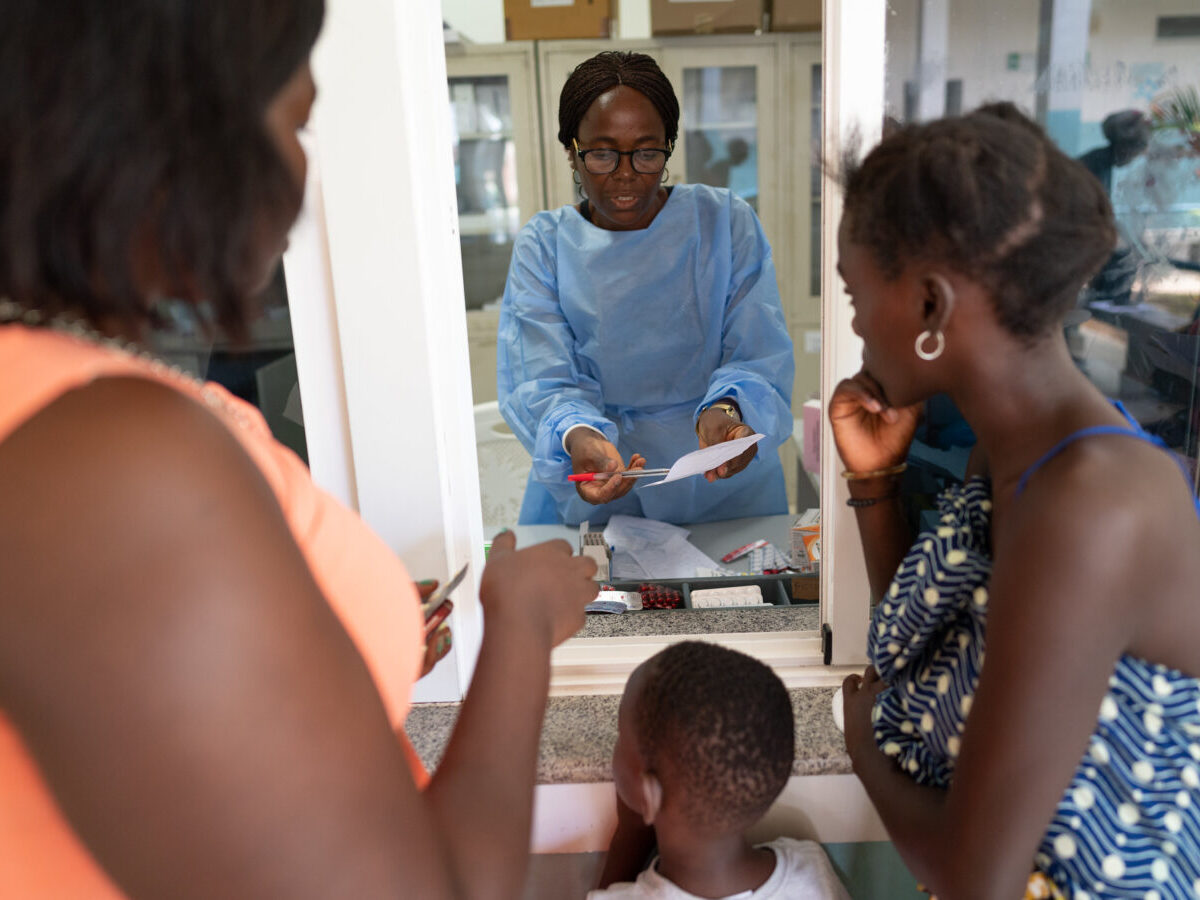
Pictured: Pharmacist Teresa Ngwe Muchinda fills a prescription at the Centro de Saúde Graça in Benguela, Angola. (Photo: Artur Francisco for ICAP)
About ICAP
A major global health organization that has been improving public health in countries around the world for two decades, ICAP works to transform the health of populations through innovation, science, and global collaboration. Based at Columbia Mailman School of Public Health, ICAP has projects in more than 40 countries, working side-by-side with ministries of health and local governmental, non-governmental, academic, and community partners to confront some of the world’s greatest health challenges. Through evidence-informed programs, meaningful research, tailored technical assistance, effective training and education programs, and rigorous surveillance to measure and evaluate the impact of public health interventions, ICAP aims to realize a global vision of healthy people, empowered communities, and thriving societies. Online at icap.columbia.edu