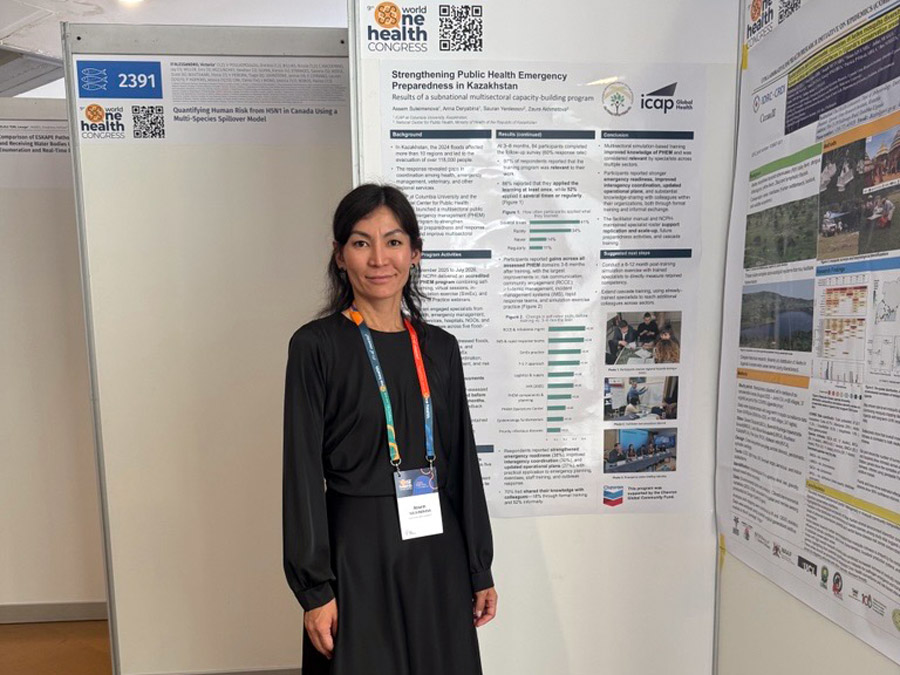
Researchers from ICAP in Kazakhstan presented new research entitled Strengthening Public Health Emergency Preparedness in Kazakhstan: Results of a subnational multisectoral capacity-building program at the 9th World One Health Congress, held September 4–7, 2026, in Lisbon, Portugal.
Assem Suleimenova, PhD, MPH, regional program coordinator for ICAP in Central Asia and lead author on the study, presented a poster summarizing results from ICAP’s public health emergency management (PHEM) capacity-building program in Kazakhstan, developed in close partnership with Kazakhstan’s National Center for Public Health (NCPH) and supported by the Chevron Global Community Fund. Suleimenova collaborated with Anna Deryabina, MD, DrPH, MScIH,ICAP’s regional director in Central Asia, along with Dr. Sauran Yerdessovl and Dr. Zaure Akhmetova of the NCPH, to conduct this research
The poster highlighted the program’s multisectoral simulation-based training, which brought together specialists from health, emergency management, veterinary services, and industry across five flood-affected regions of Kazakhstan — a direct response to coordination gaps exposed by the 2024 floods, which displaced more than 118,000 people. The program trained more than 165 multisectoral specialists across Kazakhstan’s most flood-affected regions, with participants reporting strong gains in emergency readiness, interagency coordination, and applied use of the skills learned — 70% of trained specialists went on to share their knowledge with colleagues, formally or informally.
“It was a pleasure to share our work with colleagues tackling similar multisectoral coordination challenges in other countries, and to connect with fellow Kazakhstani colleagues working across different corners of the One Health space,” said Assem Suleimenova. “One thing this Congress reinforced for me is that One Health is still fragmented — sectors that should be natural partners are often still working in parallel rather than together. There is real work ahead, especially in our region, to turn ‘One Health’ from a shared vocabulary into shared practice.”
Now in its ninth edition, the Congress is one of the world’s leading forums for advancing collaboration across human, animal, and environmental health, this year drawing participation from the World Health Organization (WHO), the Food and Agriculture Organization (FAO), the UN Environment Program (UNEP), and the World Organization for Animal Health (WOAH), alongside researchers, policymakers, and practitioners from around the globe.
View the research poster here.
About ICAP
A major global health organization that has been improving public health in countries around the world for two decades, ICAP works to transform the health of populations through innovation, science, and global collaboration. Based at Columbia Mailman School of Public Health, ICAP has projects in more than 40 countries, working side-by-side with ministries of health and local governmental, non-governmental, academic, and community partners to confront some of the world’s greatest health challenges. Through evidence-informed programs, meaningful research, tailored technical assistance, effective training and education programs, and rigorous surveillance to measure and evaluate the impact of public health interventions, ICAP aims to realize a global vision of healthy people, empowered communities, and thriving societies. Online at icap.columbia.edu