In 2013, The Democratic Republic of Congo (DRC) adopted DHIS2 (District Health Information Software 2) as the national electronic platform for health data collection, processing, and dissemination. A free, open-source software platform, DHIS2 is considered the world’s largest Health Management Information System, utilized by ministries of health in over 75 countries for national-scale health data management, covering over 40% of the global population.
More than 12 years after the adoption of DHIS2 in DRC, the PNLS (Programme National de Lutte contre le VIH/SIDA et les IST) – the official branch of the Ministry of Public Health responsible for coordinating the fight against HIV/AIDS – has continued to face a critical lack of tools enabling granular data analysis and real-time decision-making at all levels of the health system. Analyses were often performed after exporting data to tools other than DHIS2, particularly Excel spreadsheets, which represented an additional workload for users.
Since 2022, ICAP has been supporting the DRC Ministry of Health, through the PNLS, in the production of strategic information on HIV/AIDS in the country in a project funded by the US President’s Emergency Plan for AIDS Relief (PEPFAR) through the US Centers for Disease Control and Prevention (CDC),
As part of its mission to support the health system in producing high-quality strategic information, ICAP set about addressing the inefficiency faced by PNLS in the use of the DHIS 2 platform. In addition to implementing tools already developed to improve data management, ICAP undertook the development and integration within the national DHIS2 system of a new application called “HIV Insight Dashboard.” This dashboard enables all DHIS2 users to analyze reported data in granular detail to make real-time decisions – an innovative approach that dramatically improves the ability of all stakeholders involved in the fight against HIV/AIDS to use evidence-based data in their work.
“This dashboard represents a meaningful shift in HIV data use in the DRC by expanding access to high-quality data analysis across all levels of the health system,” noted Eugenie Poirot, PhD, MPH, senior technical advisor for Strategic Information at ICAP. “Rather than relying on exported datasets and external tools, any DHIS2 user, from national leadership to provincial and facility teams, can now generate timely insights directly within the national system, strengthening data quality review and enabling faster, data-driven decision-making across the DRC,”
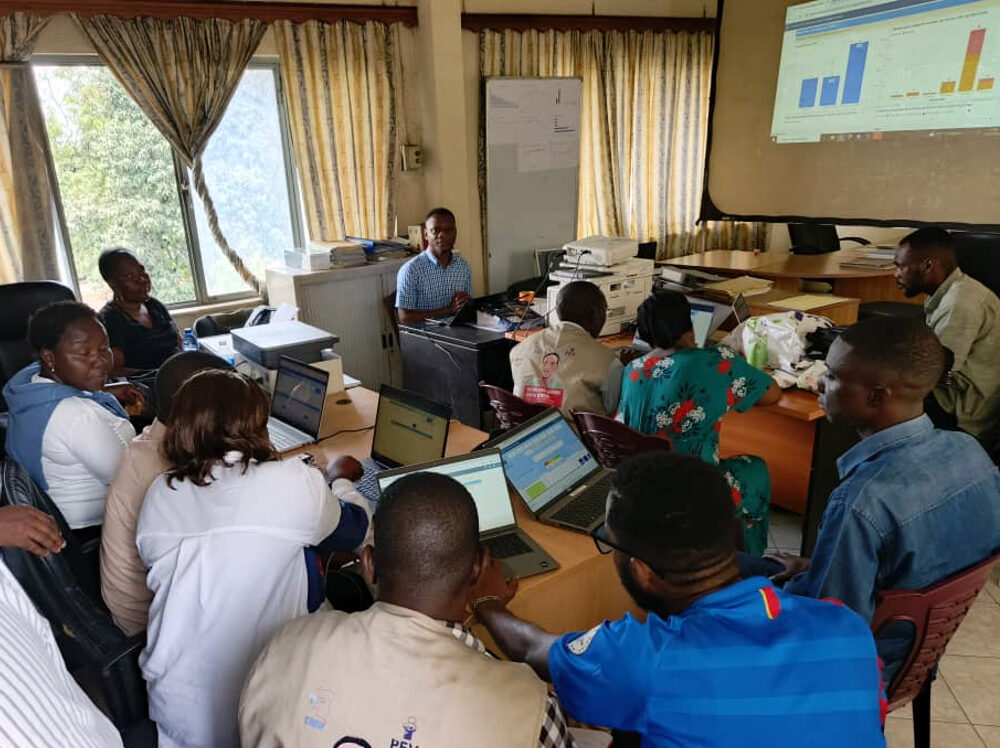
To promote the use of the dashboard, ICAP, in partnership with the PNLS, organized training sessions for Ministry of Health users and clinical coordinators, initially in the PEPFAR-supported provinces of Kinshasa, Haut-Katanga, and Lualaba, before expanding to other regions of the country.
The HIV dashboard has been adopted by PEPFAR provinces as a data source for provincial meetings and validation reviews.
To popularize the use of the dashboard nationwide, a virtual training-of-trainers session has been planned for 112 managers from the 26 provinces, with technical support from ICAP SI and led by the Planning, Monitoring, and Evaluation Division of the National PNLS.
In February 2026, Lualaba Province became the first to make the HIV dashboard the primary tool for its provincial meetings and data analyses. As a result, all presentations from health zones are directly derived from this dashboard.
Dr. Baltas Kabeya Mongaba, Medical Coordinator of the PNLS Program in Lualaba, described the change: “The HIV dashboard is the core tool we’ve been using since early 2026 for data analysis and validation. Whatever you ask for — tables, charts, maps — we can produce in a short amount of time.”
About ICAP
A major global health organization that has been improving public health in countries around the world for two decades, ICAP works to transform the health of populations through innovation, science, and global collaboration. Based at Columbia Mailman School of Public Health, ICAP has projects in more than 40 countries, working side-by-side with ministries of health and local governmental, non-governmental, academic, and community partners to confront some of the world’s greatest health challenges. Through evidence-informed programs, meaningful research, tailored technical assistance, effective training and education programs, and rigorous surveillance to measure and evaluate the impact of public health interventions, ICAP aims to realize a global vision of healthy people, empowered communities, and thriving societies. Online at icap.columbia.edu