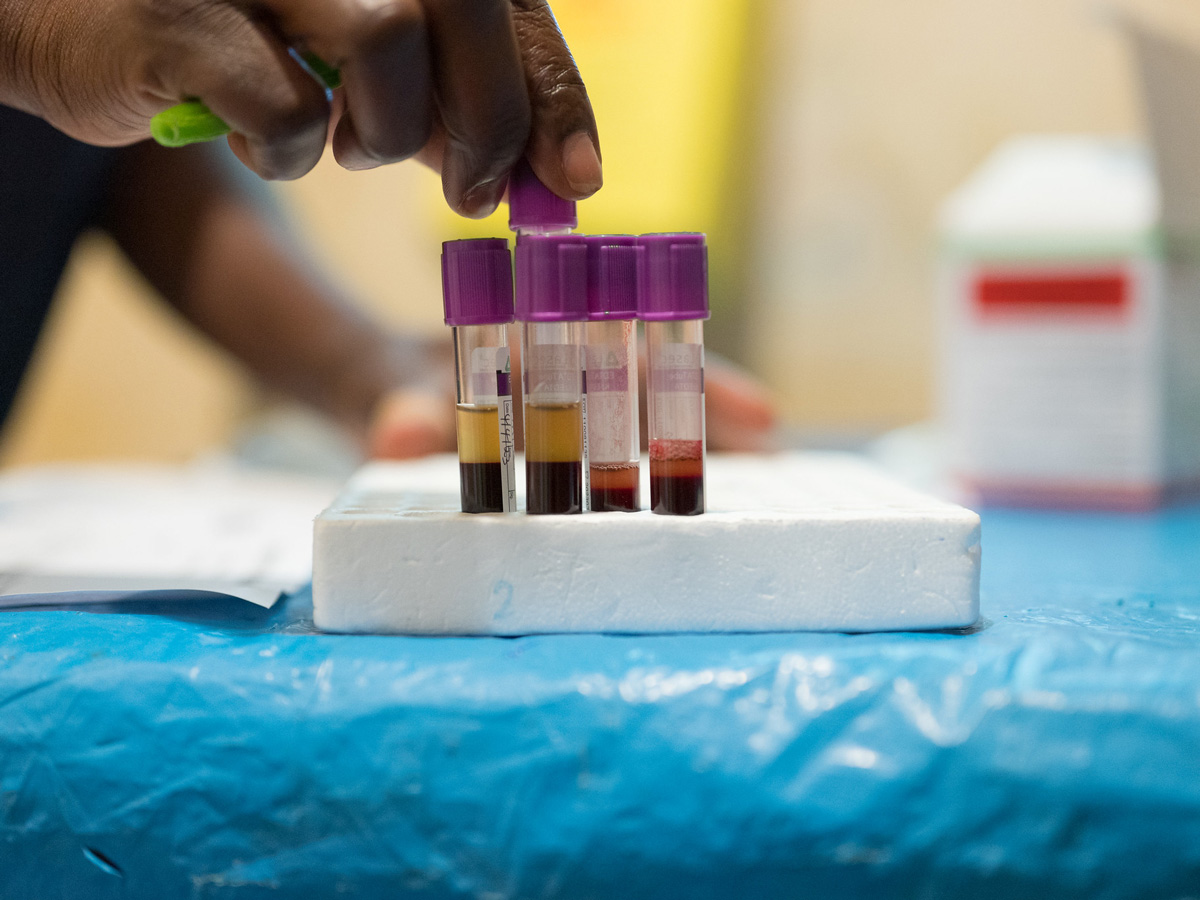
Zambia’s Northwestern Province presents specific challenges to the nation’s HIV response, including vast geographic distances that make it harder for people to reach a health care facility, and lower rates of viral suppression of HIV, which can lead to increased rates of transmission.
With support from the United States Government through the Centers for Disease Control and Prevention (CDC), ICAP in Zambia has served as a technical assistance partner to the Northwestern Provincial Health Office (NWPHO) since October 2024, working to strengthen the health system, improve service delivery, and ensure quality HIV programming across the full cascade of care in the province. To that end, in the past year, ICAP has scaled up implementation support across 357 facilities in 11 districts.
As part of this technical support, ICAP has focused on filling two critical gaps: linkage to antiretroviral therapy (ART) among individuals newly diagnosed with HIV, and tackling obstacles to optimal viral load monitoring in the province.
Closing the Gaps to Linkage to Antiretroviral Therapy
In the latter half of 2025, ICAP’s teams identified a gap in linking newly diagnosed HIV-positive individuals to care and treatment at supported health facilities. Only about 85% of clients who tested positive for HIV were successfully being linked to ART meaning that at least one in six of every newly diagnosed client was at risk for poor health outcomes. Recognizing this urgency, ICAP worked closely with NWPHO to conduct a comprehensive root-cause analysis and identify barriers to ART initiation. Challenges identified in this review included poor data quality, referral system bottlenecks, a limited number of ART sites, and suboptimal patient preparation by less-experienced counselors, which contributed to higher rates of refusal to start ART.
ICAP subsequently initiated several targeted quality improvement (QI) projects to strengthen ART initiation and linkage systems to identify service gaps, test practical solutions, and monitor progress in real time. ICAP also conducted on-site ART management orientations, particularly in counseling, patient preparation, and treatment initiation, employing innovative methods. For example, to address counseling challenges, inexperienced counselors were paired with seasoned counselors through a mentorship program. This peer support system helped improve confidence and quality in counseling. In addition, motivational counseling techniques were introduced and strengthened to help clients better understand the benefits of early ART initiation, address fears and misconceptions, and improve treatment acceptance.
These interventions significantly reduced ART refusal rates and improved same-day initiation.
To further improve access to treatment, ICAP actively participated in NWPHO-led HIV management trainings and supported efforts to increase the number of ART service delivery points across the province.
As a result, facilities began reporting stronger linkage systems, improved patient tracking, and better preparation for newly diagnosed clients to initiate ART immediately. Following the implementation of targeted interventions, linkage rates rose from the initial 85% to 96% by the end of the reporting period, reflecting measurable success. Today, the province stands stronger in its commitment to achieving epidemic control—bringing hope, health, and dignity to communities across Northwestern Province.
Improving Viral Load Monitoring
Sustaining viral load (VL) monitoring among recipients of care has marked another significant challenge for the Northwest Provincial Health Office (NWPHO). Some of the contributing factors have included poor adherence to the VL monitoring schedule standard operating procedures (SOPs) by health care workers due to inadequate knowledge and weak intra- and interdistrict courier services attributable to breakdowns in key courier components such as motorbikes. Additionally, the province’s sole polymerase chain reaction (PCR) laboratory needed renovation. These challenges, coupled with a poor results-feedback system, severely threatened the NWPHO’s ability to monitor VL.
With support from the CDC. ICAP worked with the NWPHO to reduce the impact of these viral load monitoring challenges. First, through on-site orientation and mentorship, the ICAP teams facilitated the ability of all health care workers to understand the viral load monitoring schedule. At the same time, ICAP provided vehicles and driver services to use the courier routes for sending samples to the processing lab.
While the system’s interventions improved the situation for a period, the much-needed renovations to the PCR lab in Solwezi remained a critical obstacle to optimal results. To mitigate the impact of the disruption caused by the renovation, ICAP supported the NWPHO with VL testing logistics at a secondary lab in Kitwe. During the period between January 20 and March 31, 2026, 9386 samples (8911 for VL and 475 for early infant diagnosis) were processed, with a results turnaround time of seven days.
Additionally, ICAP worked with other laboratory implementing partners to expand access to the national laboratory system, DISA, and eLabs to improve quick access to decision-making results. ICAP also continued providing support to health care workers to identify recipients of care with unsuppressed VL and enroll them in enhanced adherence counseling, which helped with sustaining VL suppression.
Since these interventions, ICAP in Zambia has continued to provide support to the NWPHO, helping facility teams update VL in the new electronic health records system, Care Pro.
As a result of these measures, VL coverage steadily improved, rising from 77% to 89%, while VL suppression remained around 97%. Without these collaborative mitigation measures by ICAP, the NWPHO and the CDC, declines in VL coverage and suppression would likely have occurred.
“Against a backdrop of reduced resources for HIV programs in Zambia and across sub-Saharan Africa, taking strategic steps to ensure the highest efficiency in diagnosis and linkage to ART has become an urgent priority,” said Tafadzwa Dzinamarira, PhD, MPH, MSc, ICAP’s country director in Zambia. “ICAP has been harnessing nearly a quarter century of expertise and experience providing technical assistance to HIV programs to identify gaps and introduce innovative solutions. The work we have undertaken in Zambia’s Northwestern Province is an example of the ways in which we are helping maintain hard-won gains in the long march toward HIV epidemic control.”
About ICAP
A major global health organization that has been improving public health in countries around the world for two decades, ICAP works to transform the health of populations through innovation, science, and global collaboration. Based at Columbia Mailman School of Public Health, ICAP has projects in more than 40 countries, working side-by-side with ministries of health and local governmental, non-governmental, academic, and community partners to confront some of the world’s greatest health challenges. Through evidence-informed programs, meaningful research, tailored technical assistance, effective training and education programs, and rigorous surveillance to measure and evaluate the impact of public health interventions, ICAP aims to realize a global vision of healthy people, empowered communities, and thriving societies. Online at icap.columbia.edu