Accreditation for quality and competence based on the ISO 15189 international standard is becoming a key requirement for bacteriology laboratories in Ukraine. The ISO 15189 standard is used by pathology and clinical labs to build reliable quality management systems and ensure accurate patient test results.
While most laboratories supported by ICAP in Ukraine are close to achieving or have already achieved this accreditation, laboratorians still require a deeper understanding of certain aspects of the accreditation standard, including risk management, quality control planning, method verification, and process documentation.
When ICAP conducted a training needs assessment among the laboratories it has been supporting, it identified these topics as the highest-priority learning needs. In partnership with a local consulting company and with support from the US Centers for Disease Control and Prevention (CDC), ICAP developed a practical training program to strengthen the competencies needed for laboratories to maintain this important accreditation.
The training, which took place over a 10-day period in May, brought together 28 participants from five hospitals, the Ukrainian Public Health Center (UPHC), and four regional Centers for Disease Control and Prevention (rCDCs). Participants included bacteriologists, quality managers, and hospital leadership.
The two-phase program was designed to maximize learning by encouraging participants to apply new knowledge in their daily work between phases.
Phase one included three online sessions focusing on quality-related principles of ISO 15189, including risk-based management, quality indicators, data analysis, and continuous improvement.
Following phase one learning, participants identified and analyzed risks within their own laboratories and prepared their findings for presentation during the in-person workshop.
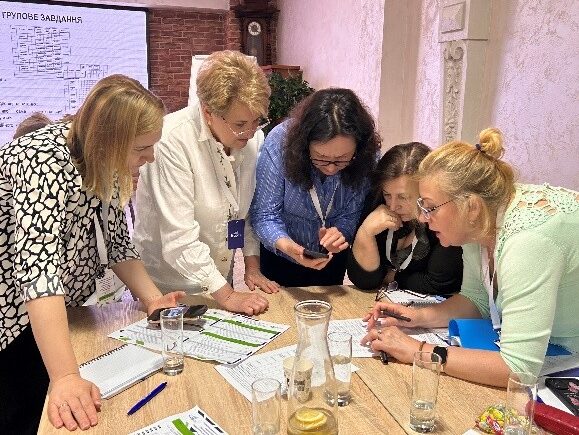
During the second phase, a three-day, in-person workshop included hands-on exercises, group work, and case discussions. Here, participants developed quality-control plans, constructed statistical quality-control charts, practiced method verification and validation, applied failure-mode and effects-analysis (FMEA)-based risk assessment, and exchanged practical solutions for implementing accreditation requirements in their laboratories.
By combining theory with practice, ICAP strengthened participants’ capacity to implement and maintain accreditation requirements, enabling their laboratories to improve test reliability and accuracy, and support clinical decision-making.

Training participants
Pre- and post-tests for in-person learning showed improvements and each participant received continuing professional development credits for the training.
The training demonstrated the value of combining expert-led instruction with practical learning to strengthen laboratory capacity. More than 90% of participants expressed satisfaction with the organization, relevance, quality, and format of the training, and with the facilitators’ expertise.
Reflecting on the experience, one bacteriologist commented “I found it extremely valuable, and the knowledge I gained helped me develop a much better understanding of the ISO 15189:2022 standard.”
Participants particularly valued the opportunity to apply ISO 15189 requirements to real-world scenarios, exchange experiences with colleagues, and discuss practical solutions to common challenges.
“The value of this type of professional development is exceptional,” noted the head of a bacteriology laboratory who participated in the training. “It provided an opportunity not only to gain new knowledge, but also to clarify challenging topics, engage in meaningful discussions, exchange experiences with colleagues, and better understand method validation.”
“ICAP’s expertise in training that brings together theory and practice made this an especially meaningful learning experience for these laboratorians,” said Ihor Novykov, MD, ICAP’s country representative in Ukraine. “Development of these skills will be reflected in improved laboratory quality and efficiency, which will contribute to a stronger health system at a critical time in Ukraine.”
About ICAP
A major global health organization that has been improving public health in countries around the world for two decades, ICAP works to transform the health of populations through innovation, science, and global collaboration. Based at Columbia Mailman School of Public Health, ICAP has projects in more than 40 countries, working side-by-side with ministries of health and local governmental, non-governmental, academic, and community partners to confront some of the world’s greatest health challenges. Through evidence-informed programs, meaningful research, tailored technical assistance, effective training and education programs, and rigorous surveillance to measure and evaluate the impact of public health interventions, ICAP aims to realize a global vision of healthy people, empowered communities, and thriving societies. Online at icap.columbia.edu