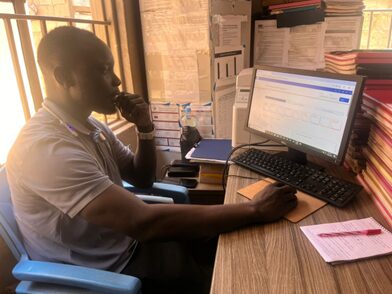
The new digital system is helping health workers track missed appointments, follow up with patients, and improve viral load monitoring across five health facilities.
In South Sudan, delivering HIV treatment presents extraordinary challenges. Health workers operate in a context shaped by displacement, limited infrastructure, and recurring disruptions to health services. An estimated 140,000 people in the country live with HIV. Until recently, HIV care at many facilities depended entirely on paper-based registers, making it hard to retrieve patient records, follow up on missed appointments, and identify people due for viral load testing. In a country where keeping people on treatment can mean the difference between life and death, those gaps matter.
With support from the U.S. President’s Emergency Plan for AIDS Relief (PEPFAR) through the U.S. Centers for Disease Control and Prevention (CDC), ICAP at Columbia University partnered with the South Sudan Ministry of Health to help close those gaps. As part of a broader health information systems strengthening effort, ICAP supported the design, testing, and rollout of South Sudan’s first case-based electronic antiretroviral therapy (ART) register, or ART E-register, a patient-level digital system built on the open-source OpenMRS platform. The electronic medical record (EMR) system was developed in alignment with the Ministry of Health’s existing systems to mirror workflows already familiar to facility staff.
ICAP introduced the system in phases. Field testing began at Munuki Primary Health Care Centre in the South Sudan capital of Juba in July 2024 and quickly expanded to four additional facilities: Al Sabah Children’s Hospital, Rumbek State Hospital, Yirol Hospital, and Yambio State Hospital. Together, the five sites account for about 17 percent of the PEPFAR-supported ART caseload in South Sudan.
ICAP trained 75 end users, supported dedicated data entry teams, and digitized more than 12,700 legacy patient records. The system was designed not just to replace paper, but to help providers act. It generates line lists (information to track patients), flags clients who miss appointments, and supports follow-up for services such as viral load testing, tuberculosis screening, and treatment adherence counseling.
By early 2026, routine monitoring across the five sites showed encouraging improvement. Between May 2025 and February 2026, the proportion of missed appointments declined from 58 percent to 11 percent, while the number of recorded interruptions in treatment fell from 159 to 89. Concordance between paper and electronic records reached 98 percent. Cumulatively through February 2026, 7,373 of 9,221 eligible clients, or 80 percent, had viral load samples collected.
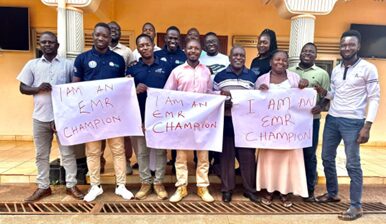
Facility-based EMR champions providing day-to-day mentorship and supporting adoption across the five E-register sites.
At the facility level, health workers described immediate practical benefits. “We can locate a client using the unique ART number or name, which saves time during clinic days,” said an ART clinic manager at Yambio State Hospital. “It also allows us to quickly retrieve a patient’s treatment history even when a client arrives without their treatment card, ensuring continuity of care and reducing delays in service delivery.”
At Al Sabah Children’s Hospital, an ART clinician described a similar change for younger clients: “The system automatically generates line lists for adolescents and young people aged 10 to 24, enabling us to easily track individual clients and monitor key services, including refill dates for antiretroviral medications and viral load sample collection.”
ICAP also worked to position the system for continuity beyond the project period. Facility-based EMR champions provided day-to-day mentoring, while a five-day “hackathon” in Juba in August 2025 helped transfer the code base and strengthen local technical capacity for system maintenance. ICAP later handed over a structured transition package, including technical documentation, training materials, and deployment guides, to support continued use beyond the project period.
“The gains at the five facilities reflect careful groundwork: alignment with national clinical workflows, dedicated data entry capacity, and strong Ministry of Health engagement from the outset,” said Mansoor Farahani, MPH, DSc, principal investigator of ICAP’s Strengthening Health Information in South Sudan project. “Our focus now is on sustaining these gains, supporting the Ministry of Health and care and treatment partners, and preparing the system for use beyond the current sites.”
In South Sudan, where every client retained in care represents a hard-won gain, the ART E-register is helping health workers turn data into action and giving the country a stronger foundation for more responsive, more accountable HIV care.
About ICAP
A major global health organization that has been improving public health in countries around the world for two decades, ICAP works to transform the health of populations through innovation, science, and global collaboration. Based at Columbia Mailman School of Public Health, ICAP has projects in more than 40 countries, working side-by-side with ministries of health and local governmental, non-governmental, academic, and community partners to confront some of the world’s greatest health challenges. Through evidence-informed programs, meaningful research, tailored technical assistance, effective training and education programs, and rigorous surveillance to measure and evaluate the impact of public health interventions, ICAP aims to realize a global vision of healthy people, empowered communities, and thriving societies. Online at icap.columbia.edu