A Success Story from ICAP’s Health Information Systems Strengthening Work — October 2022 – March 2026
Between October 2022 and March 2026, ICAP at Columbia University supported the South Sudan Ministry of Health (MOH) to design, test, and deploy the country’s first case-based, open-source electronic antiretroviral therapy (ART) register (“ART E-register”). This work was implemented as part of a broader health information systems (HIS) strengthening project funded by the U.S. President’s Emergency Plan for AIDS Relief (PEPFAR) through the U.S. Centers for Disease Control and Prevention (CDC).
South Sudan’s HIV response operates in one of the world’s most challenging environments. With nearly 140,000 people estimated to be living with HIV in 2023, including more than 8,100 new infections and 5,600 AIDS-related deaths that year, and approximately 70,416 individuals receiving ART as of mid-2024, the ability to track, retain, and manage patients in care is a matter of direct consequence for survival. The ART E-register was designed as an intervention to address this challenge.
Built on the OpenMRS 3.x platform, the ART E-register was deployed across five health facilities in three states. These sites were selected for their programmatic importance and together account for approximately 17% of PEPFAR-supported ART treatment volumes and 15% of national ART treatment volumes.
ICAP and partners followed a phased implementation approach: field testing began at Munuki Primary Health Care Centre (PHCC) in July 2024 and expanded to four additional facilities by August 2024. Across the five facilities, 75 end users were trained, and more than 12,700 legacy patient records were digitized. Routine program monitoring data from the Monthly PEPFAR Dashboard show improvements in several operational indicators across the five implementation sites. Between May 2025 and February 2026, the proportion of missed appointments declined by 81% (from 58% to 11%), and the number of clients recorded as interruption in treatment (IIT) declined by 44% (from 159 to 89). Routine paper-to-electronic data verification showed high concordance, reaching up to 98%, and cumulatively through February 2026, 80% of eligible clients (7,373 of 9,221) across the five facilities had viral load (VL) samples collected. A separate synthetic-control evaluation submitted to AIDS 2026 found a more complex early rollout pattern at two high-volume facilities: recorded IIT initially increased relative to comparison sites, a pattern consistent with improved case identification, data maturation, and reporting stabilization during transition, while return-to-treatment (RTT) moved in a favorable direction under the primary analysis and several alternative specifications.
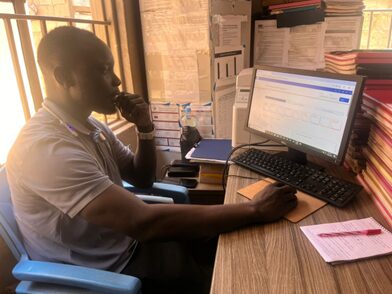
Beyond digitizing paper forms, the ART E-register was designed as a clinical decision-support tool. It generates line lists, identifies clients who miss appointments, and supports follow-up actions that can prevent clients from being lost to care. Sustainability-oriented actions—such as a five-day hackathon to migrate the codebase, a structured artifacts transition package from the development partner, and a defined handover model for ongoing operations—position the system for continued use beyond the project period.