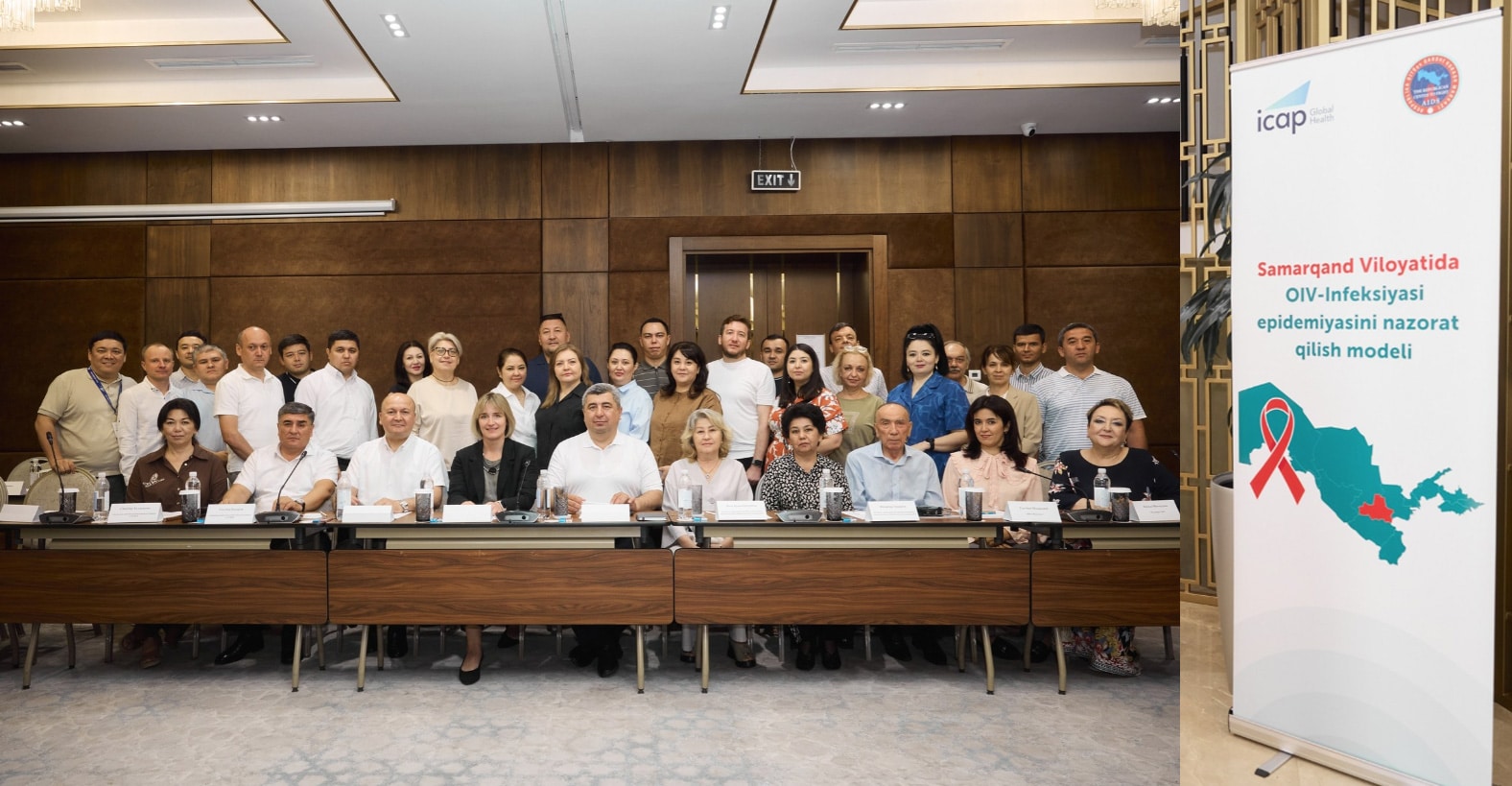
A dynamic new effort led by ICAP at Columbia University is set to improve testing, treatment, and prevention of HIV in Uzbekistan. On July 8, 2025, ICAP— in close partnership with the Sanitary-Epidemiological Welfare and Public Health Committee of the Republic of Uzbekistan, the Republican AIDS Center, and the Samarkand Regional AIDS Center—officially launched the “Samarkand Model for HIV Epidemic Control.”
Uzbekistan, one of Central Asia’s largest and most populous countries, reported 50,156 people living with HIV as of January 1, 2025 with 44,550 (89%) of them receiving lifesaving antiretroviral therapy (ART)—well below the levels needed to bring the longstanding epidemic under control.
The majority of new HIV cases in the country are diagnosed among people in the 19–45 age group—the backbone of the nation’s workforce—making epidemic control both a public health and socio-economic priority. As Samarkand is one of Uzbek regions with the highest numbers of people living with HIV, it stands as a priority for intensified intervention.

Ismoil Jafarov – Financial Coordinator of the Global Fund, presented information on the activities of the Global Fund in Uzbekistan.
The “Samarkand Model for HIV Epidemic Control” aims to develop and implement a comprehensive, sustainable, and effective regional program to control the HIV epidemic in the Samarkand region. The program, which is aligned with the global UNAIDS 95-95-95 targets that chart a path to ending the epidemic, aims to:
- Strengthen health care system capacity to sustainably improve the quality of services for key populations, including people living with HIV;
- Expand access to high-quality, community-based HIV testing, prevention, and treatment services;
- Reduce structural barriers, such as stigma and discrimination, that hinder equitable access to care;
- Build the capacity of NGOs and enhance their collaboration with health care providers.
The official launch of the project brought together government representatives, health care professionals, NGOs, and international partners. Attendees at the launch ceremony in Tashkent received updates on the current HIV situation in Uzbekistan, challenges specific to the Samarkand region, and the project’s implementation roadmap. Active discussion followed, with participants expressing strong support for the project’s innovative, first-of-its-kind approaches.
“This project is just the first step in our continued collaboration with ICAP,” remarked Dr. Botirjon Kurbanov, deputy head of the Sanitary-Epidemiological Service. “In the future, we also hope to expand our collaboration to address other public health priorities together.”
“Uzbekistan has long awaited the launch of this project, and we will do everything in our power to fully achieve its goals. We also hope that the project will expand to other regions of the country,” noted Dr. Bahromjon Igamberdiev, Head of the Republican AIDS Center.

Jamshid Umarov – Epidemiologist at the Republican AIDS Center, presented information on the HIV epidemiological situation in the Samarkand region.
“We are ready to collaborate and committed to improving service delivery with the help of experienced experts,” said Dr. Ulugbek Nazarov, head of the Samarkand Regional AIDS Center.
“The Samarkand Model for HIV Epidemic Control builds on lessons learned and proven interventions from the RADIAN-funded Almaty Model for Epidemic Control, which ICAP implemented in Kazakhstan with the support of the Elton John AIDS Foundation,” said Dr. Anna Deryabina, ICAP’s regional director for Eurasia. “Together with our partners in Uzbekistan, we will adapt these approaches to the local context and explore additional innovative interventions.”
The official launch ceremony was followed by an inception visit of ICAP staff to Samarkand, during which they met with the AIDS Center leadership and local HIV providers to initiate implementation of project activities. As part of the visit, a training was held on July 9–10 at the Samarkand Regional AIDS Center, where staff received hands-on instruction in innovative methods aimed at strengthening early detection, linkage to care, and prevention strategies.
The Samarkand Model is a pilot initiative, designed to demonstrate the impact of early case detection, timely treatment initiation, and multidisciplinary team (MDT) collaboration. Joining ICAP, the Republican AIDS Center, and the Samarqand Regional AIDS Center to implement the project will be a local NGO Istiqlolli Avlod as well as the another Ngo that will work with people living with HIV.
“If successful, the Samarkand Model could be scaled nationwide and serve as a blueprint for comprehensive HIV epidemic control across Uzbekistan,” said Dr. Deryabina.
About ICAP
A major global health organization that has been improving public health in countries around the world for two decades, ICAP works to transform the health of populations through innovation, science, and global collaboration. Based at Columbia Mailman School of Public Health, ICAP has projects in more than 40 countries, working side-by-side with ministries of health and local governmental, non-governmental, academic, and community partners to confront some of the world’s greatest health challenges. Through evidence-informed programs, meaningful research, tailored technical assistance, effective training and education programs, and rigorous surveillance to measure and evaluate the impact of public health interventions, ICAP aims to realize a global vision of healthy people, empowered communities, and thriving societies. Online at icap.columbia.edu