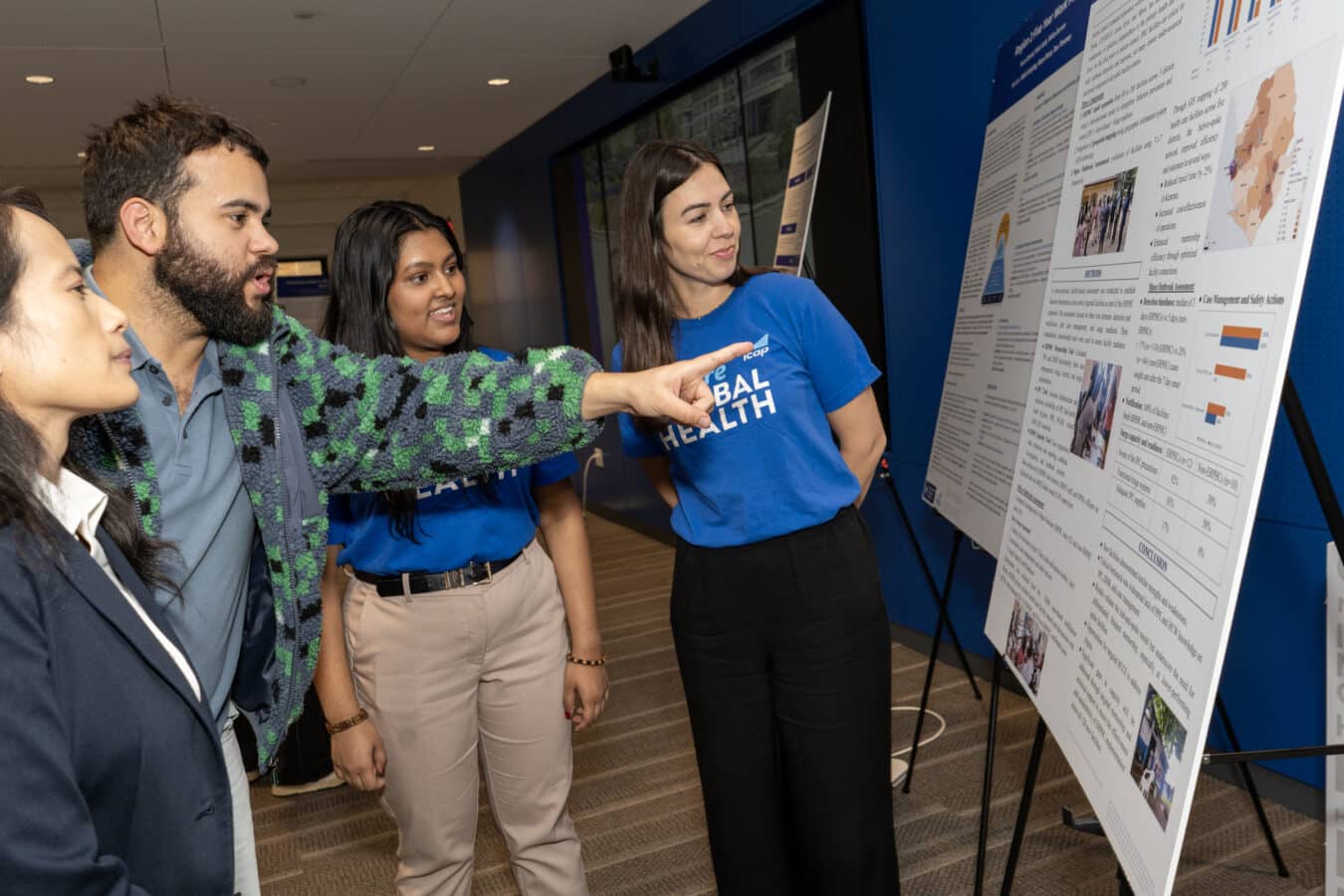
The future of global public health was on display at the Columbia Mailman School of Public Health on November 3rd as ICAP’s Next Generation Interns showcased the research the students conducted as part of their hands-on global public health experiences over the past year.
The Next Generation program is a core component of ICAP’s commitment to preparing future leaders through formative internships and training programs. ICAP’s student training programs are multi-disciplinary, aiming to bring together students with different interests and from various academic disciplines, and have provided students with on-the-ground experience in exciting, mentored and structured environments. Students work side-by-side with ICAP staff in one of the many ICAP country offices around the world as well as at its well-established research sites in Harlem and the Bronx in New York City as well as the NYC Pandemic Response Institute. To date, ICAP has contributed to advancing educational and training opportunities for more than 300 students from various institutions.
ICAP’s Next Generation Interns annually exhibit research projects developed during their internships as the culmination of an intensive and challenging introduction to global health – from research to action.
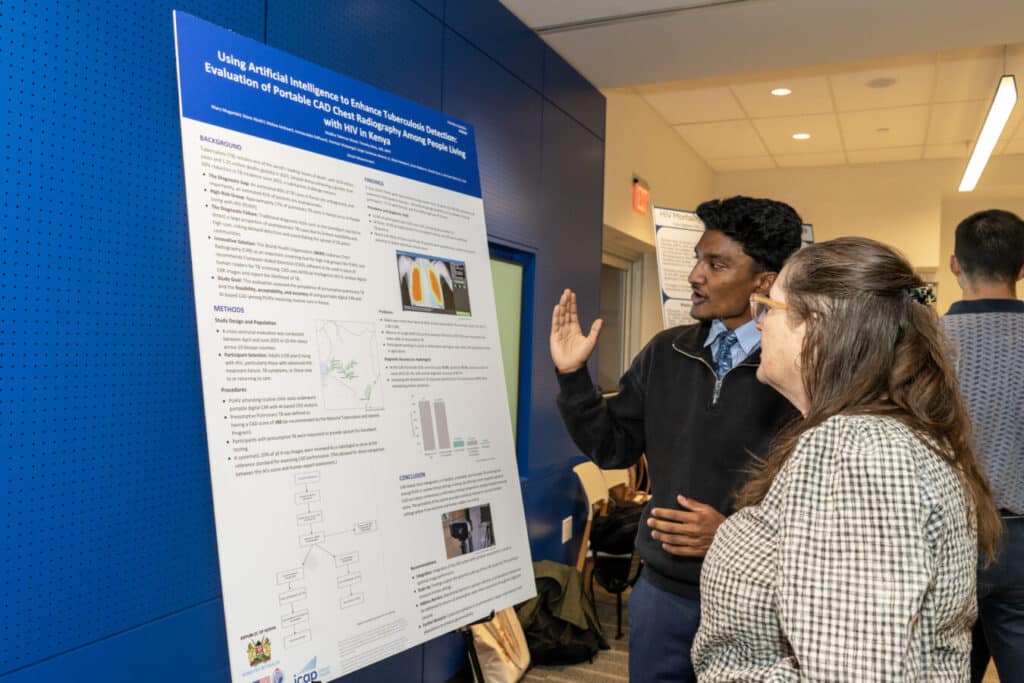
CUNY Brooklyn College student, Mujibur Shaad, discusses his research from Kenya on utilizing AI to detect TB.
For this year’s poster session, the students displayed a wide gamut of studies on subjects ranging from epidemic preparedness in Sierra Leone to the dynamics of contraception in Eswatini and an evaluation of tuberculosis treatment options for pregnant and breastfeeding women.
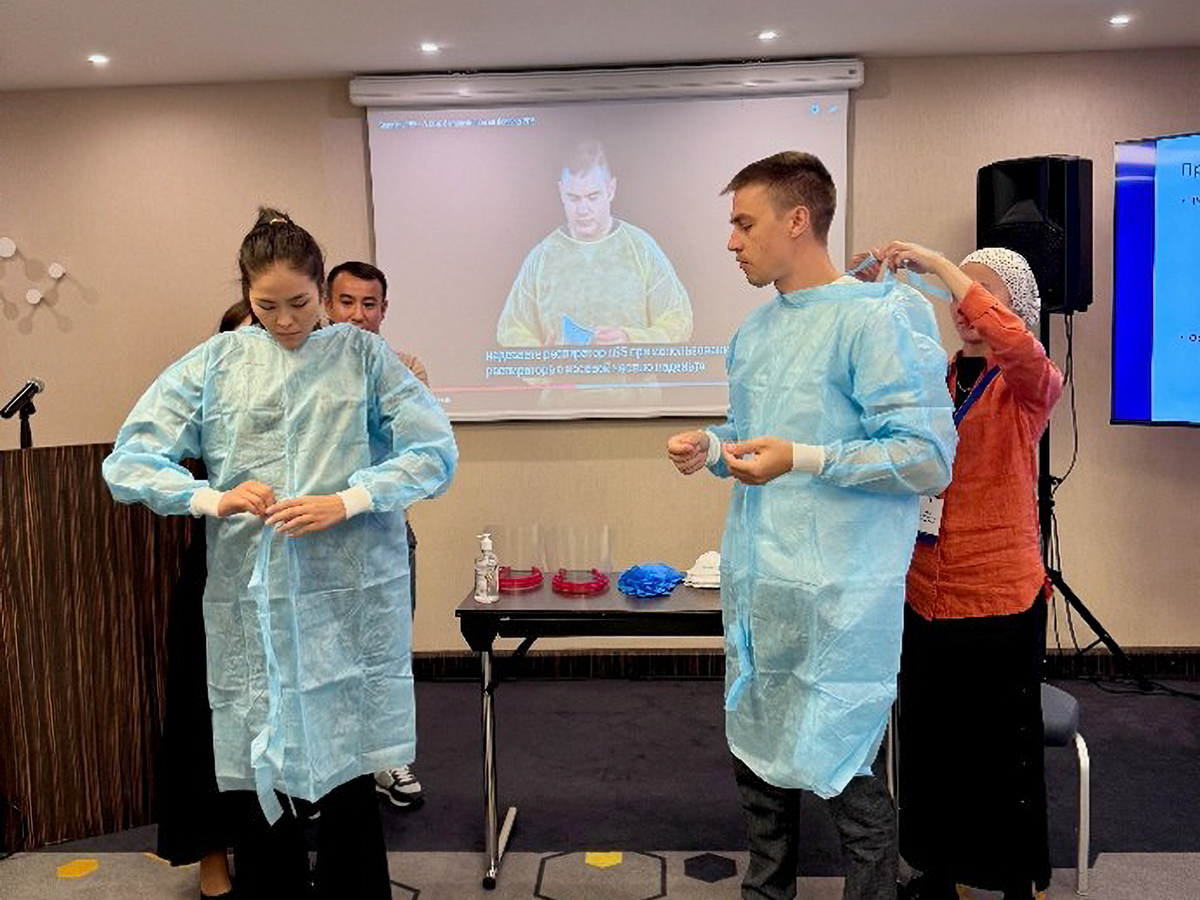
This year’s showcase included studies conducted by a special cohort of students from CUNY Brooklyn College under the newly launched Tow Global Student Engagement Program, made possible with generous support from the Tow Foundation. As part of their training, the Brooklyn College students had launched their internship through a week-long Public Health Bootcamp in which they were exposed to foundational ideas in public health and critical information for health and safety during travel.
The Brooklyn College students join interns from the Columbia Mailman School of Public Health, Columbia University Irving Medical Center’s Vagelos College of Physicians and Surgeons, and the NYC Preparedness and Recovery Institute (NYC PRI). Together, the students brought a wide variety of backgrounds to the program, with majors ranging from epidemiology and psychology to bioethics and nutrition.
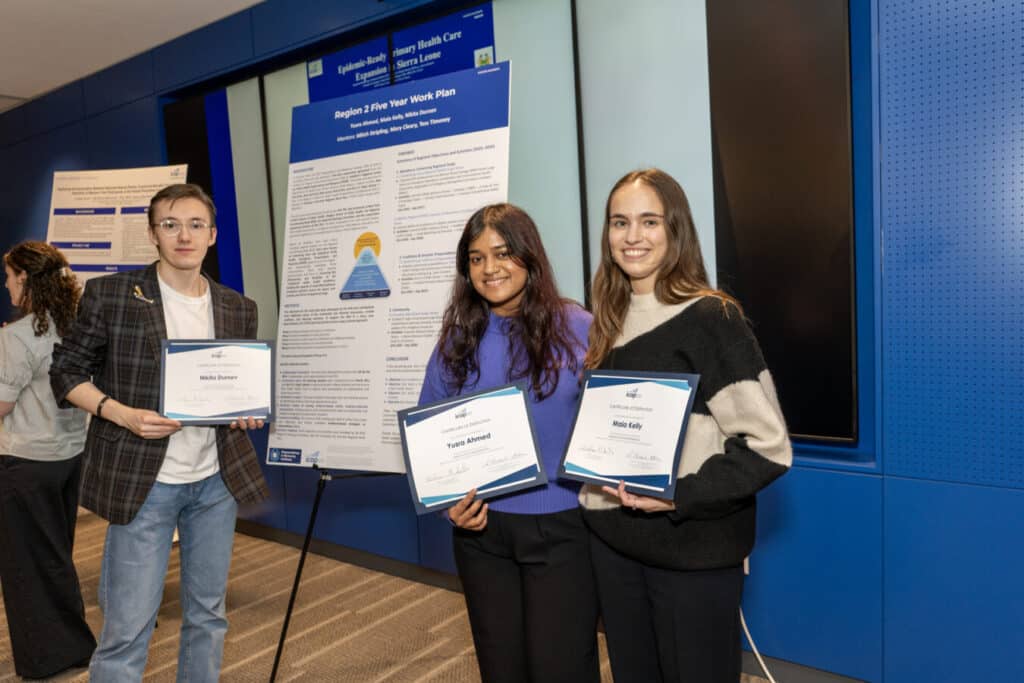
Maia Kelly, Nikita Durnev, and Yusra Ahmed received certificates of distinction for their contributions to a public health preparedness workplan for the Preparedness and Recovery Institute.
As participants in the program attested, their Next Generation internship was an eye-opening and formative experience.
“Being an ICAP intern in Kenya has truly changed my life,” said Mujibur Shaad from CUNY Brooklyn College, whose research explored the use of artificial intelligence to enhance tuberculosis detection in people living with HIV. “It allowed me to see the world through a new lens, meet incredible people, and experience the power of community while witnessing the impact of global health work firsthand. I left Kenya with a deeper sense of gratitude, purpose, and a transformed view of the world and my place within it.”
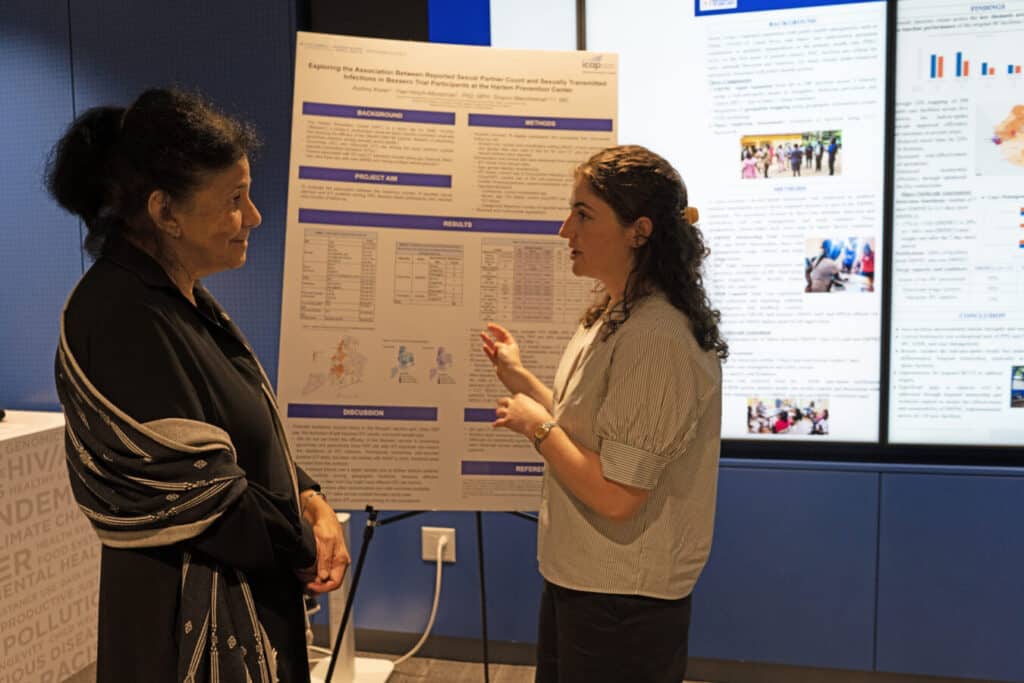
ICAP’s global director, Wafaa El-Sadr, listens as Audrey Koren talks about her research on the association between reported sexual partner count and sexually transmitted infections in Bexsero trial at the Harlem Prevention Center.
“My ICAP Next Generation internship at the Harlem Prevention Center was an extremely rewarding experience that solidified my desire to pursue a career in clinical research and to ultimately earn a PhD,” said Audrey Koren, who contributed two abstracts to the poster sesssion – one on sexually transmitted diseases and the other infection prevention and control. “Most importantly, my internship deepened my understanding of the critical need to support clinical trials and to ensure the inclusion of underrepresented populations in research.”
This year, three posters were selected as Poster of Distinction for their excellence in research and presentation. Charlaine Roberto, Mirele Pereria, Alexis Ricketts and Khematie Rambharan were chosen for their poster Epidemic-Ready Primary Health Care Expansion in Sierra Leone exploring how they scaled up the ERPHC program in various facilities in Sierra Leone. Audrey Koren was chosen for her poster Exploring the Association Between Reported Sexual Partner Count and Sexually Transmitted Infections in Bexsero Trial Participants at the Harlem Prevention Center, which analyzed data on participants in a clinical trial. Maia Kelly, Nikita Durnev, and Yusra Ahmed were chosen for their poster on Region 2 Five Year Work Plan which described the work they did the research and prepare a work plan for NYC PRI.
For more information on ICAP’s Next Generation Program, click here.
A complete list of the posters presented follows.
| Poster Title | Location | Students |
| Epidemic-Ready Primary Health Care Expansion in Sierra Leone | Freetown, Sierra Leone | Charlaine Roberto, Mirele Pereria (Columbia Mailman)
Alexis Ricketts, Khematie Rambharan (Brooklyn College) |
| Using Artificial Intelligence to Enhance Tuberculosis Detection: Evaluation of Portable CAD Chest Radiography Among People Living with HIV in Kenya | Nairobi, Kenya | Mujibur Shaad (Brooklyn College)
Timothy Muia (Columbia Mailman) |
| Barriers to Viral Load Coverage in Northwestern Province, Zambia | Lusaka and Northwestern Province, Zambia | Radyah Ibnat (Brooklyn College) |
| HIV Mortality Audit, Northwest Province Zambia | Lusaka and Northwestern Province, Zambia | Tyler Nghiem (Columbia Mailman)
|
| A Desk Review of Cervical Cancer Screening Quality Improvement Initiatives in Western Province, Zambia, 2021-2024 | Lusaka and Northwestern Province, Zambia | Chidiogo Nwakoby ( Columbia Vagelos College of Physicians & Surgeons) |
| How the ISURGE Model Influences RHIS Use, Data-Driven Decision-Making in Zambia’s North-Western Province | Lusaka and Northwestern Province, Zambia | Anitta Kottai (Brooklyn College)
|
| Implementing New Modules for Intensive Longitudinal Survey: Dynamics of Contraception in Eswatini | New York City | Kelly Andrew (Columbia Mailman) |
| Root Cause Analysis of Infection Prevention and Control Programs in Ebola-affected Health Zones in the Democratic Republic of the Congo | Harlem Prevention Center | Audrey Koren, Ceidy Ovalle (Columbia Mailman) |
| Exploring the Association Between Reported Sexual Partner Count and Sexually Transmitted Infections in Bexsero Trial Participants at the Harlem Prevention Center | Harlem Prevention Center | Audrey Koren (Columbia Mailman) |
| The Radiant Mom Study | Harlem Prevention Center | Hanna Amanuel Tesafahunei (Columbia Mailman) |
| Promoting Linkage to HIV Care Among Migrant Workers | Harlem Prevention Center | Noelle Anna Thomas (Columbia Mailman) |
| Region 2 Five Year Work Plan | New York City | Maia Kelly, Nikita Durnev, Yusra Ahmed (NYC Preparedness and Recovery Institute) |
About ICAP
A major global health organization that has been improving public health in countries around the world for two decades, ICAP works to transform the health of populations through innovation, science, and global collaboration. Based at Columbia Mailman School of Public Health, ICAP has projects in more than 40 countries, working side-by-side with ministries of health and local governmental, non-governmental, academic, and community partners to confront some of the world’s greatest health challenges. Through evidence-informed programs, meaningful research, tailored technical assistance, effective training and education programs, and rigorous surveillance to measure and evaluate the impact of public health interventions, ICAP aims to realize a global vision of healthy people, empowered communities, and thriving societies. Online at icap.columbia.edu