
Severely strained due to war, Ukraine’s health system faces significant challenges, including mass casualties and prolonged hospitalizations that facilitate the spread of healthcare-associated infections (HAIs). Among these, infections with carbapenem-resistant organisms (CROs) pose a particular threat.
CROs are bacteria that are resistant to last-line treatments and may produce carbapenemases – enzymes that actively break down carbapenem antibiotics. Because they have a high potential for spread within hospitals and are difficult to treat, they pose substantial challenges to healthcare facilities in Ukraine and abroad.
The frequency with which patients become colonized with CROs after hospital admission can serve as a gauge to evaluate the effectiveness of infection prevention and control (IPC) practices in the hospital. CRO screening serves as a critical component of IPC to ensure the timely implementation of measures to counter the spread of priority disease threats.
With support from the US Centers for Disease Control and Prevention (CDC), ICAP at Columbia University initiated colonization screening for CROs in four Ukrainian public inpatient hospitals in February and March 2026. The primary goal of this work is to identify patients who are colonized, or carrying bacteria without symptoms of infection. These patients are at increased risk of developing an infection and spreading resistant bacteria to others.
Each participating hospital selected two clinical departments, either surgical or intensive care, that provide treatment to both civilian and military patients. Each of these departments collects a rectal swab from eligible adult patients who agree to participate at admission, transfer, and discharge. Hospital teams then test the specimens for CROs and carbapenemase production in the laboratory, report results back to the departments and implement IPC measures for colonized patients. To assess the progress, performance, and impact of colonization screening, hospital teams collect a comprehensive dataset.
In collaboration with partners, ICAP provided technical support to hospitals for their participation in colonization screening and CDC’s Global Action in Healthcare Network-Antimicrobial Resistance Module (GAIHN-AR), including:
- Developing a protocol based on GAIHN-AR, which was granted a non-research determination by Columbia University Institutional Review Board in February 2025 and approved by the Ethics Committee of the State Institution “Public Health Center of the Ministry of Health of Ukraine” in July 2025.
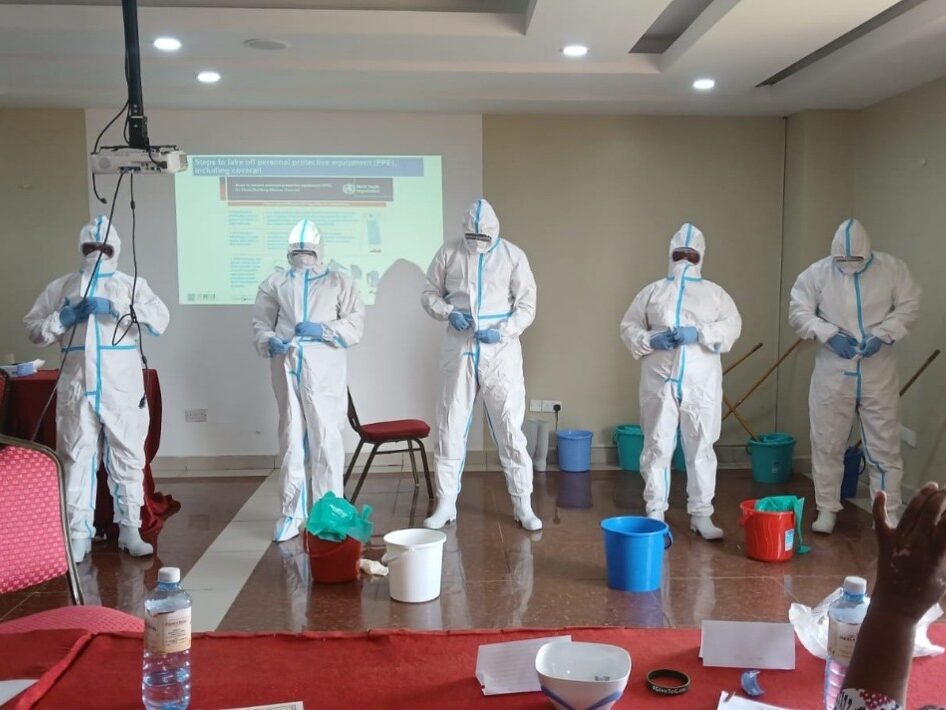
- Training 17 representatives of hospital IPC departments, laboratories and participating clinical departments from October 14–16, 2025 in Ivano-Frankivsk, Ukraine.
- Facilitating a 24-hour pilot implementation of the protocol using a point prevalence survey (PPS) approach in October–November 2025. During the pilot period, 209 patients were undergoing treatment in or admitted to the participating clinical departments.
- Conducting a refresher training for 28 participants before transitioning to routine screening on February 4–5, 2026. In addition to IPC and lab representatives, physicians and nurses from participating clinical departments joined the training.
- Initiating colonization screening in February–March 2026 at all four hospitals for all eligible consenting patients admitted to participating departments.
Participating hospitals have been learning from their experience with colonization screening, including on hospital that developed a tracking spreadsheet to streamline their workflow and reduce the administrative burden for nursing staff.
Colonization screening is establishing an evidence-based foundation to support future antimicrobial resistance prevention and control efforts to more effectively prevent the spread of high-risk pathogens across Ukraine and abroad.
“Laboratory testing during CRO screening helps us detect carbapenemase-producing organisms in patients both at admission and discharge, especially in high-risk units like ICUs and surgical wards,” said the head of IPC at one of the ICAP supported hospitals. “With consistent access to supplies provided by ICAP, we are now able to identify resistance mechanisms and determine the types of carbapenemases in Enterobacteriaceae, as well as better understand their local spread. This information directly supports our infection control team in taking timely and targeted actions to prevent and contain the spread of CRO.”
About ICAP
A major global health organization that has been improving public health in countries around the world for two decades, ICAP works to transform the health of populations through innovation, science, and global collaboration. Based at Columbia Mailman School of Public Health, ICAP has projects in more than 40 countries, working side-by-side with ministries of health and local governmental, non-governmental, academic, and community partners to confront some of the world’s greatest health challenges. Through evidence-informed programs, meaningful research, tailored technical assistance, effective training and education programs, and rigorous surveillance to measure and evaluate the impact of public health interventions, ICAP aims to realize a global vision of healthy people, empowered communities, and thriving societies. Online at icap.columbia.edu