
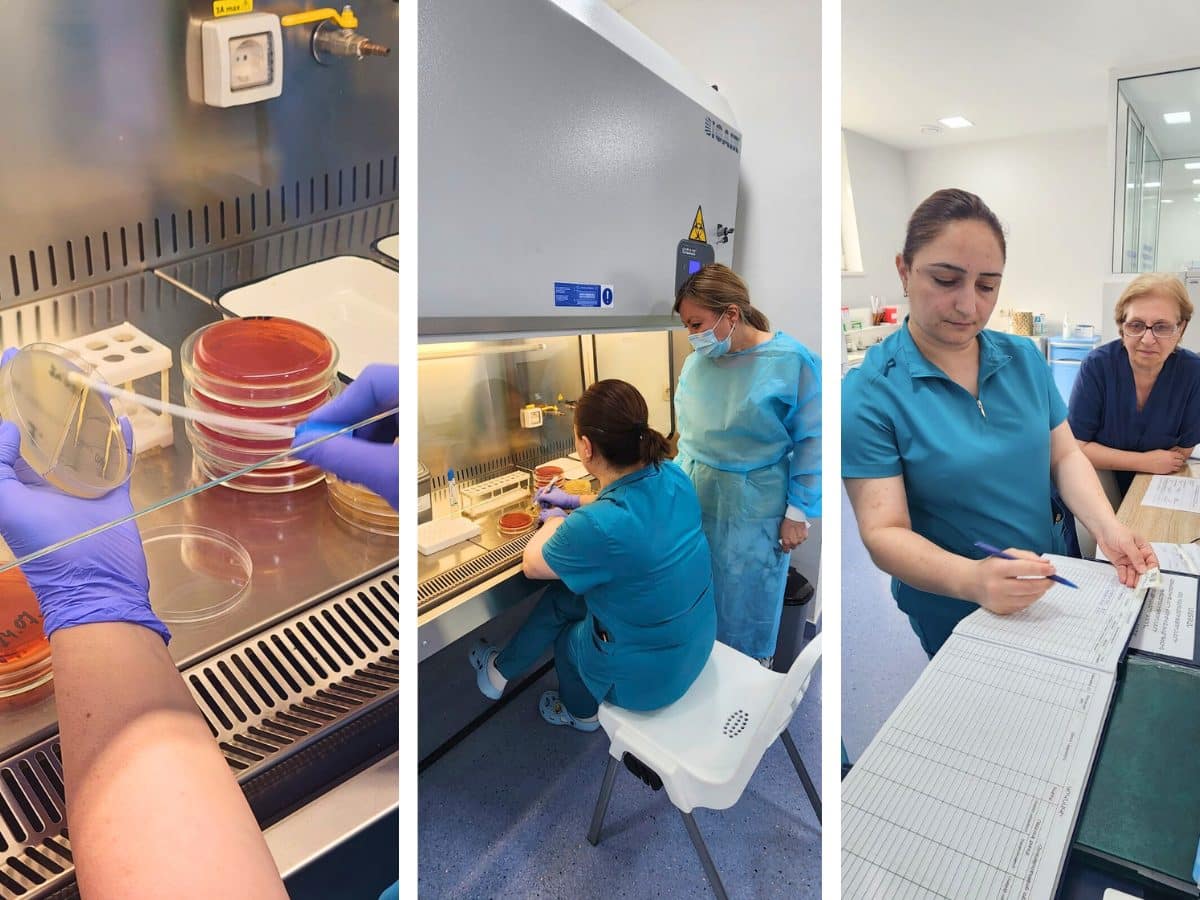
Antimicrobial resistance (AMR) poses a significant challenge to health care systems worldwide and is a growing public health concern in Armenia. With the onset of the COVID-19 pandemic in 2020, the use of antibiotics in Armenia increased significantly; patient misuse, poor prescribing practices, and limited screening contributed to the challenge.
In collaboration with the U.S. Centers for Disease Control and Prevention (CDC), the Ministry of Health (MOH) of Armenia, and the National Center for Disease Control and Prevention (NCDC), ICAP at Columbia University launched colonization screening of two conditions resistant to commonly prescribed antibiotics to prevent the spread of resistant bacteria in Armenia – and support Armenia’s broader efforts to address AMR.
At St. Gregory Medical Center, one of the largest hospitals in Armenia, ICAP initiated colonization screening for carbapenem‑resistant Enterobacterales (CRE) and methicillin‑resistant Staphylococcus aureus (MRSA), antibiotic-resistant pathogens that can cause serious infections. Colonization screening uses laboratory testing to detect if a person is carrying – or colonized with – a multidrug-resistant organism without showing symptoms of illness.
Data collection for the colonization screening was launched on July 25, 2025, and scheduled to continue through September 12. All consenting adult patients over the age of 18 admitted to the intensive care unit (ICU) with no current CRE or MRSA infection undergo colonization screening within 24 hours of admission, followed by a second round of screening one week after admission, discharge, or transfer from the ICU to another ward or facility.
ICAP worked closely with the CDC to develop the study protocol and data collection forms, and to finalize logistical arrangements, including establishing quality assurance mechanisms for the NCDC reference laboratory.
“The launch of this project is a significant advancement for our intensive care unit,” said Dr. Grigor Manucharyan, head of the ICU at St. Gregory’s. “By identifying colonization with drug-resistant organisms at admission and discharge, we gain critical insights into their burden and transmission dynamics. This enables us to implement evidence-based precautions, enhance patient safety, and strengthen our overall infection prevention and control practices. It represents a meaningful step toward more informed clinical care and improved outcomes.”
While screening will help determine baseline prevalence of CRE and MRSA among adult patients admitted to the ICU, other essential interventions, such as updating hospital standard operating procedures and training of staff, are also being implemented simultaneously. CDC and ICAP provided mentorship for laboratory and clinical staff to ensure adherence to standardized sampling, transport, data management, and laboratory testing procedures.
“Strengthening antimicrobial resistance surveillance and infection prevention practices is a public health priority, particularly in high-risk settings such as intensive care units,” said Maia Kajaia, senior AMR public health specialist for the CDC Eastern Europe and Central Asia (EECA) regional office. “This project at St. Gregory represents a critical step toward advancing Armenia’s capacity to detect, prevent, and respond to antimicrobial resistance in health care settings. By introducing colonization screening and reinforcing the use of transmission-based precautions, it addresses key system gaps, generates essential data on drug-resistant organisms, and promotes sustainable practices that enhance patient safety and inform national AMR control efforts.”
“We hope that the colonization screening results will help inform infection prevention strategies and targeted interventions at both facility and national levels while also strengthening laboratory and surveillance capacity for AMR in Armenia,” said Anna Deryabina, regional director of ICAP in Eurasia.

PPS training in Armenia
In addition to colonization screening support, ICAP began working with CDC, NCDC, and the World Health Organization in April 2025 to provide training to data collectors and validation teams for the first national point prevalence survey (PPS) to assess health care-associated infections (HAIs) and antimicrobial use at 35 multi-specialty hospitals in Armenia.
AMR can make HAIs significantly more difficult to treat. The PPS, which is a snapshot study that collects standardized data at a specific moment in time to measure the prevalence of a condition, will aim to ultimately improve awareness, training, and surveillance capacity.
About ICAP
A major global health organization that has been improving public health in countries around the world for two decades, ICAP works to transform the health of populations through innovation, science, and global collaboration. Based at Columbia Mailman School of Public Health, ICAP has projects in more than 40 countries, working side-by-side with ministries of health and local governmental, non-governmental, academic, and community partners to confront some of the world’s greatest health challenges. Through evidence-informed programs, meaningful research, tailored technical assistance, effective training and education programs, and rigorous surveillance to measure and evaluate the impact of public health interventions, ICAP aims to realize a global vision of healthy people, empowered communities, and thriving societies. Online at icap.columbia.edu