Bacteriological laboratories in Ukraine increasingly face the challenge of how to improve both the quantity and quality of the clinical specimens that they test. While low specimen quantity remains an issue, ensuring high quality is critically important for reliable diagnostics and effective patient treatment.
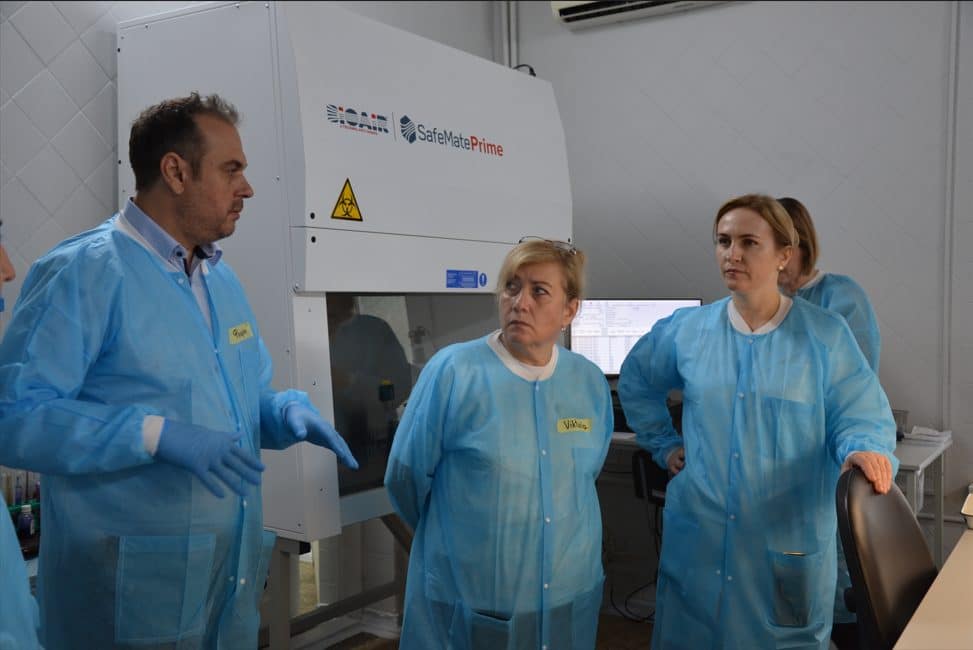
Addressing this need, ICAP organized two practical mentorship workshops for a total of 10 bacteriologists from eight supported hospital laboratories. The main goal was to enhance practical skills in collecting specimens and assessing specimen quality, with an emphasis on blood and wound specimens. ICAP engaged Dr. Florin Horhat, a clinical microbiologist from Victor Babeș University Hospital, Romania, to conduct these workshops. Dr. Horhat shared international best practices and his own experiences during two multi-day training sessions.
The mentorship activities featured didactic education and hands-on training, including:
- Practical sessions with clinical specimens. Participants worked with blood and wound specimens received by the laboratory, focusing on the correct application of Gram staining methods, quality scoring for wound specimens, and identifying signs of blood culture contamination.
- Joint visits to clinical departments. Dr. Horhat visited surgical and intensive care units to observe and provide feedback to healthcare workers on the specimen collection process, for both blood and wound specimens.
- Educational sessions for clinicians and nurses. Dr. Horhat conducted lectures on best practices for specimen collection, aiming to improve communication between clinicians and bacteriologists and to raise awareness about the importance of processes to ensure specimen quality.
Before and after the training, ICAP measured participants’ knowledge about collecting specimens and assessing specimen quality. The results showed notable improvements, with the average pre-test score of 88% increasing to 92% in the post-test for the 5-day training, and from 80% to 94% for the 3-day training.

A workshop participant practices Gram staining of blood specimens.
In addition to the knowledge and skills gained by the bacteriologists during the trainings, each laboratory that participated in the workshops initiated a small-scale quality improvement (QI) project focusing either on implementing monitoring of blood culture contamination or introducing wound specimen quality assessment using quality or “Q” scores.
Bacteriologists who participated in the workshop reported that it was a productive and valuable experience.
“The main highlight of this training was the opportunity for live interaction with an outstanding expert of European level,” said Olena Yunusova, head of a regional bacteriological laboratory. “The organizers ensured there was dedicated time for communication, which was extremely important to me. I was able to practically assess how to implement the knowledge we gained during the lectures. We are now applying the sample quality assessment methodology for wound specimens and providing physicians with feedback to improve sample collection techniques. I also gained valuable insights into the assessment criteria for contamination levels, which we are now using in our daily work. Special thanks to the organizers for delivering the training at the highest level.”
“Professor Florin Horhat provided invaluable real-time guidance on clinical wound samples, demonstrating through microscopy how to differentiate between high-quality and substandard specimens,” said Natalia Krasii, a bacteriologist from a regional hospital. “He clearly outlined the criteria for inadequate samples, which we collaboratively applied to our clinical cases. The professor also conducted a joint analysis of blood sterility samples, explaining the criteria for understanding colonization and identifying improperly collected material. Furthermore, he helped us optimize Gram staining times to achieve excellent microscopy results. This training was incredibly informative and was immediately integrated into our laboratory’s practical activities.”
About ICAP
A major global health organization that has been improving public health in countries around the world for two decades, ICAP works to transform the health of populations through innovation, science, and global collaboration. Based at Columbia Mailman School of Public Health, ICAP has projects in more than 40 countries, working side-by-side with ministries of health and local governmental, non-governmental, academic, and community partners to confront some of the world’s greatest health challenges. Through evidence-informed programs, meaningful research, tailored technical assistance, effective training and education programs, and rigorous surveillance to measure and evaluate the impact of public health interventions, ICAP aims to realize a global vision of healthy people, empowered communities, and thriving societies. Online at icap.columbia.edu