Health care-associated infections (HAI) and antimicrobial resistance (AMR) remain urgent global public health threats and, in Kazakhstan, they pose a growing challenge. Many health care staff responsible for infection prevention and control (IPC) still lack structured and practical training in IPC fundamentals, HAI surveillance, and epidemiologic methods.
To strengthen the Kazakhstan health system in this critical area, ICAP at Columbia University, in close partnership with the U.S. Centers for Disease Control and Prevention (CDC) and the National Center for Public Health (NCPH) of the Ministry of Health of Kazakhstan, has successfully piloted the national Infection Prevention and Control (IPC) Foundational Course for hospital epidemiologists and multidisciplinary team members.
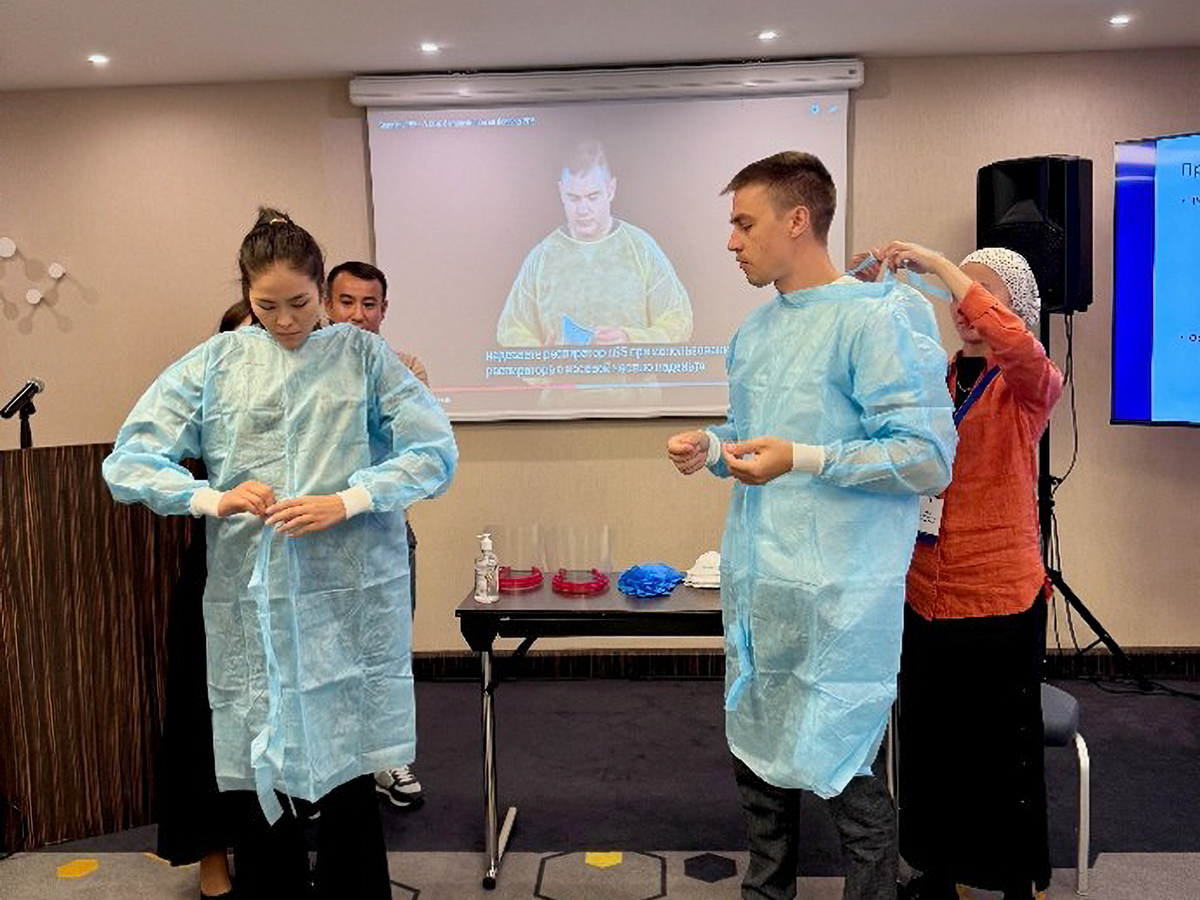
The IPC Foundational Course integrated design and comprehensive approach ensured that theoretical knowledge was reinforced through real-world application and supported by ongoing mentorship. The program consisted of two intensive, one-week in-person workshops, incorporating practical case scenarios and hands-on exercises to simulate real health care challenges, separated by a four-week period of on-the-job fieldwork and mentorship.
During the fieldwork phase, participants were tasked with assessing the IPC core components in their facilities using the WHO Infection Prevention and Control Assessment Framework (IPCAF), completing the WHO Hand Hygiene Self-Assessment Framework, and developing corresponding action plans to strengthen hand hygiene systems, as well as reviewing and improving staff safety operating procedures and integrating IPC requirements into routine workforce management processes.

Participants in the IPC Foundational Course participate in a practical session about hand hygiene
Twenty hospital epidemiologists, facility leaders, and physicians from multiple regions of Kazakhstan completed the three-month program. Each received a Certificate of Advanced Training in IPC at a ceremony held on November 7, 2025 in Almaty.
Participants in the course found the experience to be highly educational. “The training broadened my perspective as an epidemiologist,” said one graduate of the program. “It has completely changed how I approach daily IPC work and conduct surveillance.”
“The practical stations were extremely useful,” noted another. “Reviewing our mistakes and learning how to correct them immediately was invaluable.”
By expanding Kazakhstan’s network of professionals equipped with advanced IPC competencies, the course supports national efforts to reduce HAIs, strengthen patient safety, and improve emergency preparedness. The structure of the course is also designed to be adapted and scaled for use in other regions and countries in the future.
Through close collaboration among NCPH, ICAP, and CDC, Kazakhstan is building a stronger, more resilient health care system that is increasingly capable of preventing infections and protecting patients nationwide.
About ICAP
A major global health organization that has been improving public health in countries around the world for two decades, ICAP works to transform the health of populations through innovation, science, and global collaboration. Based at Columbia Mailman School of Public Health, ICAP has projects in more than 40 countries, working side-by-side with ministries of health and local governmental, non-governmental, academic, and community partners to confront some of the world’s greatest health challenges. Through evidence-informed programs, meaningful research, tailored technical assistance, effective training and education programs, and rigorous surveillance to measure and evaluate the impact of public health interventions, ICAP aims to realize a global vision of healthy people, empowered communities, and thriving societies. Online at icap.columbia.edu