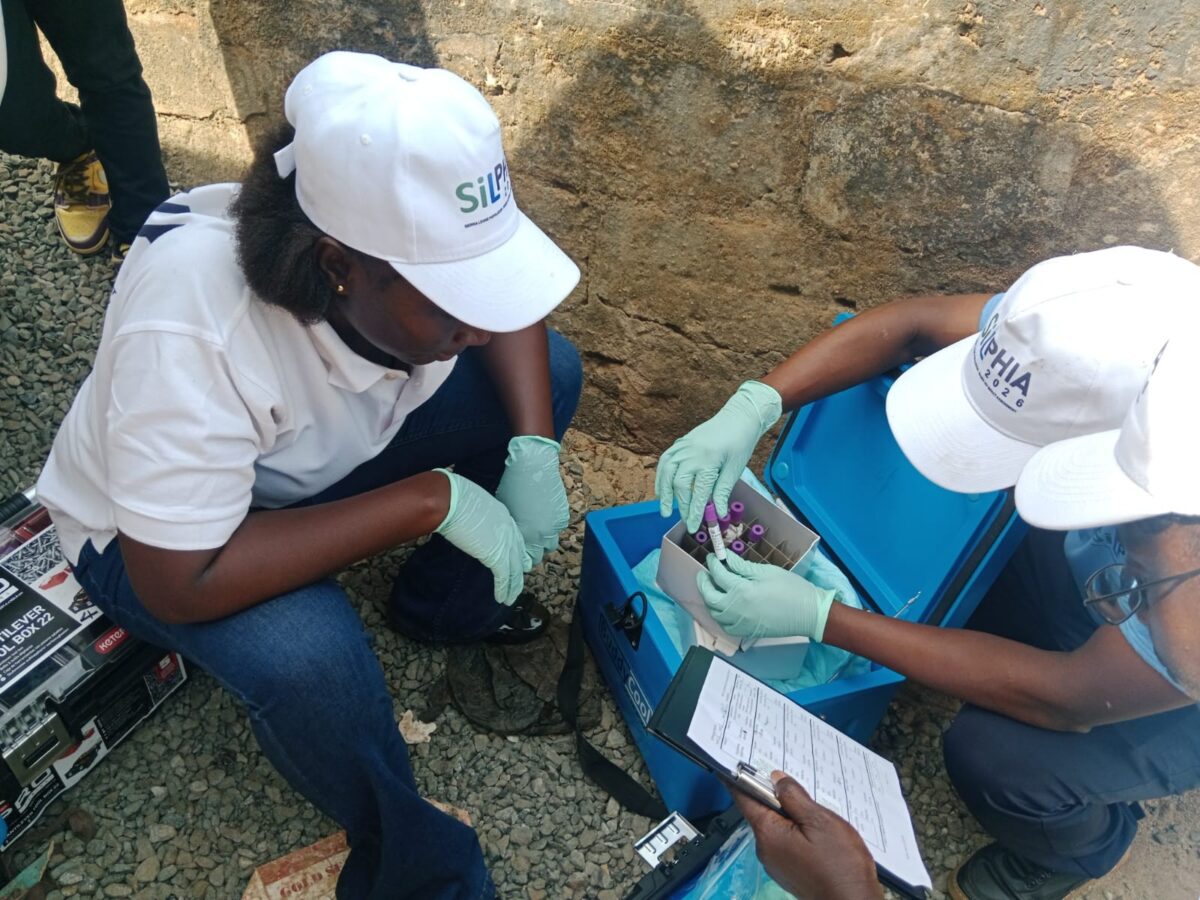
In the West African nation of Sierra Leone, the stage is being set for a major survey to gauge the status of the HIV epidemic. The 2026 Sierra Leone Population-based HIV Impact Assessment –known as SiLPHIA 2026 – is a household-based survey that will assess the prevalence of key HIV-related health indicators in the western part of the country.
SiLPHIA 2026 is the latest effort in the global Population-based HIV Impact Assessment (PHIA) project, which, since 2014, has conducted nationally representative surveys to capture the state of the HIV epidemic in the world’s most-affected countries, assessing their progress toward achieving the critical UNAIDS 95-95-95 goals, which serve as a roadmap toward achieving HIV epidemic control. The PHIA project is led by the ministry of health in each participating country and funded by the U.S. President’s Emergency Plan for AIDS Relief (PEPFAR) through the U.S. Centers for Disease Control and Prevention (CDC) with technical support from ICAP.
Sierra Leone represents the 17th country surveyed under the PHIA project, and SiLPHIA 2026 is the 26th survey ICAP has supported as part of this landmark initiative.
With a population of about 8 million, Sierra Leone has an estimated 77,600 people living with HIV. Overall prevalence of HIV is 1.7%, with a higher rate in urban areas and more women than men affected. Prevalence varies by region and district, with the highest rate (3.4%) found in the Western Area Rural, which is one of two areas on which SilPHIA will focus, along with the Western Area Urban.
Despite a low reported prevalence in 2019, there has been a rise in the number of new case findings. Moreover, HIV services across the country are not evenly distributed, which has led to gaps in certain districts. The increasing number of new infections among adolescents and young women is also a cause for concern.
The survey, which will offer home-based HIV testing and counseling with same-day return of HIV rapid test results, will estimate viral load suppression among HIV-positive individuals, as well as other HIV-related measures, such as the prevalence of detectable antiretrovirals, and information pertaining to the 95-95-95 UNAIDS and 98-98-98 Sierra Leone-targets. In addition, SiLPHIA will collect information on the uptake of and access to HIV-related services and will estimate the prevalence of selected behaviors typically associated with HIV acquisition and transmission and of common HIV co-morbidities and other health conditions.
“SiLPHIA 2026 will give Sierra Leone the first data of this kind on HIV prevalence and viral load suppression,” said Brigadier General Professor Foday Sahr, executive director for the National Public Health Agency (NPHA) and Sierra Leone’s principal investigator for SiLPHIA 2026. “This is how we measure our true progress towards the 95-95-95 targets.”
This survey of 4,445 randomly selected households in the Western Area of Sierra Leone will include approximately 12,240 eligible adults aged 15 years and older, of whom 11,798 are expected to participate in the interview. Of the participants to be interviewed, 10,166 are expected to participate in blood draws and HIV testing.
In preparation for the launch of data collection in late February 2026, the SiLPHIA teams engaged in an extensive training program that began on January 13 and continued through February 18. The training sessions involved approximately 200 staff members who received instruction in key survey skills, including community mobilization, household-level data collection, laboratory procedures, as well as monitoring and supervision.
“Every great survey starts long before the first household is visited — it starts in the training room,” said Eric Ikoona, MD, PhD, director of SiLPHIA 2026 for ICAP in Sierra Leone. “When our field teams understand not only what to do but why it matters, they carry the purpose of SiLPHIA 2026 into every community they serve. This training is our investment in the precision and integrity that Sierra Leone’s HIV response demands.”
Data collection for SilPHIA 2026 is expected to be ongoing through May 2026. Once data has been collected, it will be analyzed and followed by the release of a summary sheet with initial findings. Further along, a final report and full data sets will be issued and made available to global health researchers.
“The Ministry of Health is fully committed to SiLPHIA 2026. With the generous support of the United States Centers for Disease Control and Prevention, this survey will provide the population-level evidence to inform the impact of our interventions and identify gaps in our HIV cascade and strengthen service delivery,” said Dr. Sulaiman Lakoh, director, Disease Prevention and Control, Sierra Leone Ministry of Health, and chairperson, SiLPHIA 2026 Technical Working Group.
“The PHIA Project embraces strong and effective partnerships to change the course of the HIV epidemic and SilPHIA 2026 will provide critical information on the status of the HIV epidemic and the response in region of Sierra Leone most affected by the epidemic,” said Erika Fazito, PhD, PHIA project director. “These data will be essential for tracking progress and informing future interventions and resource allocation to help the country make progress toward ending HIV/AIDS as a public health threat.”
About ICAP
A major global health organization that has been improving public health in countries around the world for two decades, ICAP works to transform the health of populations through innovation, science, and global collaboration. Based at Columbia Mailman School of Public Health, ICAP has projects in more than 40 countries, working side-by-side with ministries of health and local governmental, non-governmental, academic, and community partners to confront some of the world’s greatest health challenges. Through evidence-informed programs, meaningful research, tailored technical assistance, effective training and education programs, and rigorous surveillance to measure and evaluate the impact of public health interventions, ICAP aims to realize a global vision of healthy people, empowered communities, and thriving societies. Online at icap.columbia.edu